
AI SOFTWARE WarriorPlus
Meridian Review 2026: Local KDP Almanacs & Town Claims
Generate location-specific KDP almanacs with computed astronomy and server-side town-edition claims
Sponsored link authorized by the publisher; affiliate tracking and merchant checkout conditions have not been independently verified.
Quick verdict
Meridian by Thu Thao/Nova AI Platform is a web-based local almanac engine using claimed deterministic astronomy and public climate data for location-specific books. Seller currently claims 257,000+ towns in 14 countries, 5 languages, ~140-page 6x9 PDF interiors, full-wrap covers, listing drafts and seven keywords. Core launches from historical $17 product reference and includes 5 templates and 25 template+town+year+language claims. Claim only blocks other Meridian users, not other publishers or legal ownership. Current Amazon KDP restricts creation and first submission to 2 new titles per format per week. Vendor dedicated refund policy says final sales; general Terms include inconsistent guarantee wording. No hands-on data accuracy audit, sale proof or refund test.
Who it may suit
Creators comparing features, workflows and their own production needs.
Potential strengths
- Location-specific computed-data book concept differs from generic blank journals
- Five distinct product almanac templates for different interests
Check carefully
- No exclusivity outside Meridian: third-party authors may publish the same town and datasets
- Amazon KDP limit of two new book titles created and submitted per format each week restricts scale
What can you do with this tool?
Illustrative workflows, not first-hand performance guarantees.
Hometown night-sky keepsake
Create and independently proof a location-specific astronomy paperback.
U.S. gardening-reference calendar
Check NOAA station normals and local relevance before promoting planting windows.
Local fishing-time almanac
Offer a solunar timing reference with clear disclaimers and realistic expectations.
Key features worth exploring
Vendor-described functions, with the checks buyers should make before relying on them.
Local-data books, not generic AI stories
Astronomy, planting, weather, prayer times and solunar fishing tailored to a real town.
Twenty-five in-app edition claims
Claims apply to template+town+year+language only; no legal exclusivity.
Paperback interior and cover
Seller advertises approximately 140 pages, 6x9 interior, cover and listing drafts.
KDP scale constraints
Amazon currently limits new title creation and first submission to two per format weekly.
How the workflow works
Suggested evaluation sequence; actual controls and package options may vary.
Research town demand and availability
Check that the correct geographic location exists and its claim is unused.
Select Core template, year and language
Avoid spending a limited claim on an unsuitable edition.
Generate and audit the output
Verify samples of astronomy, climate or prayer times and all local time-zone rules.
Proof the paperback
Check 6x9 interior, spine, charts, permissions, listing copy and print proof.
Ready to explore Meridian?
See current features, package terms, licensing and refund details on the vendor website. This review does not guarantee availability or outcomes.
Sponsored link authorized by the publisher; affiliate tracking and merchant checkout conditions have not been independently verified.
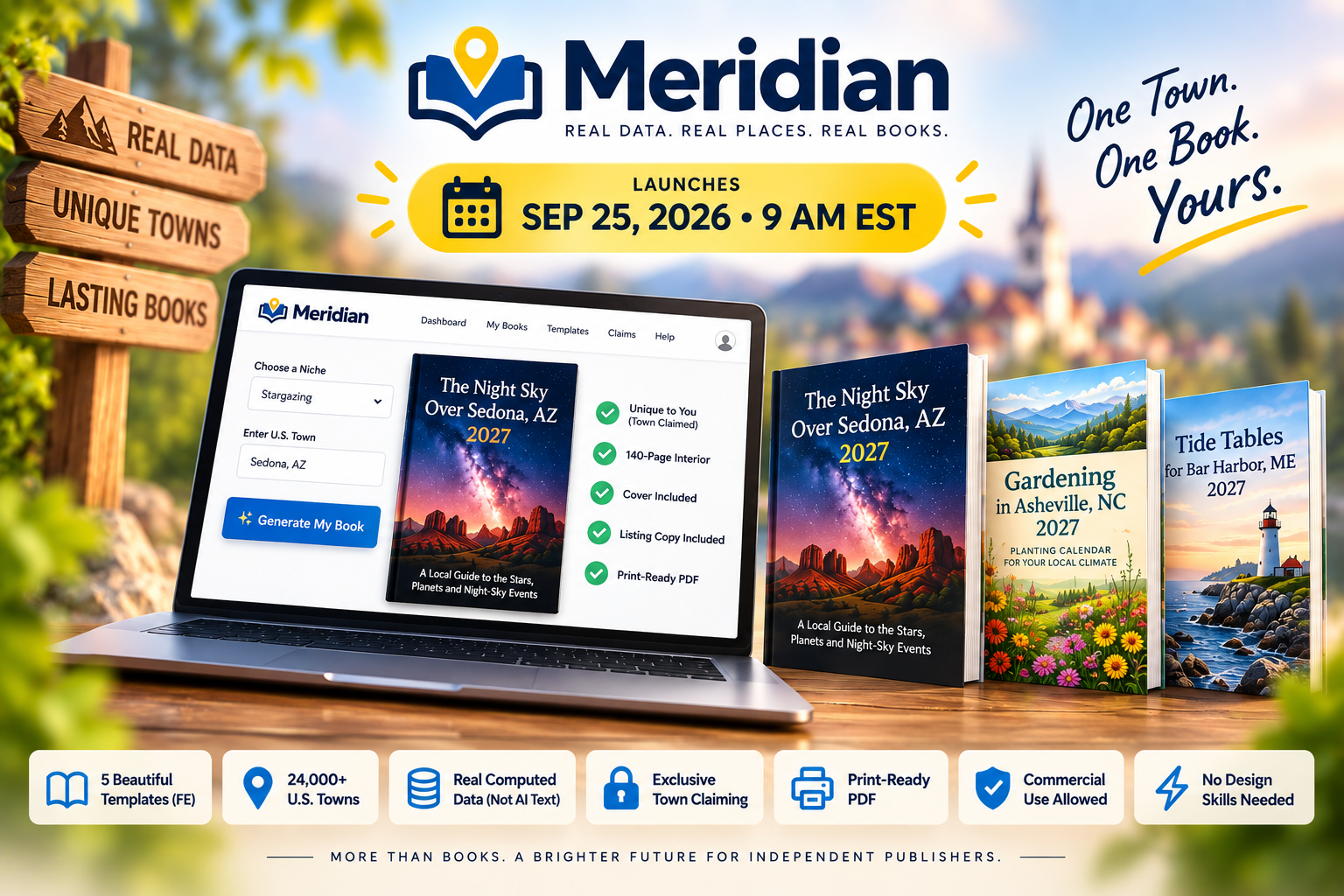
Meridian review (2026): Meridian is a browser-based data-book publishing tool that builds location-specific almanacs for Amazon KDP. Enter a town, choose a supported template and year, and the seller says it can prepare an approximately 140-page, 6×9-inch paperback interior with computed astronomy, climate or calendar information specific to that place. The downloadable package is advertised to include a full-wrap cover, suggested book listing, seven backend keywords and a certificate recording your claim inside Meridian.
Its unusual marketing promise is that you can make books your competitors “physically cannot make.” The actual restriction is much narrower: Meridian locks a particular template + town + year + language combination against other Meridian accounts. That does not stop independent publishers using different tools from calculating the same public data, creating competing almanacs or publishing for the same town.
In this Meridian review we check the core templates and 25 included claims, the advertised 257,000+ places across 14 countries, multilingual editions, deterministic-data assertions and printed-file preparation. More importantly, we examine the 2026 Amazon KDP two-new-titles-per-format-per-week limit, the real meaning of town claiming and a vendor refund policy that says sales are final. We distinguish a potentially useful specialized data generator from the seller’s unverified scarcity and income assumptions.
Affiliate and editorial disclosure: Top Deal Discoveries may receive a commission if readers purchase through the sponsored WarriorPlus links in this article, at no additional cost to the buyer. This is a research-based analysis of official seller documentation and Amazon KDP rules, not a hands-on paid test. We have not bought Meridian, generated a complete book, verified 365 daily calculations, claimed a town or measured actual book sales. Images are official seller examples rather than our independent outputs.
Meridian Review: Key Facts at a Glance
- Product: Meridian, a local-data almanac and paperback interior generator for KDP and printable publishers.
- Seller: Thu Thao, Nova AI Platform, through WarriorPlus.
- Original launch: September 25, 2026. This article was researched October 15, 2026.
- Core launch price reference: $17 one-time on the current seller presentation and official JV materials; actual checkout determines your price.
- Town coverage: seller currently claims 257,000+ towns across 14 countries. Older marketing cited smaller inventories; we have not verified each location.
- Core templates: Night Sky, When to Plant, The Weather Year, Prayer Times and Solunar Fishing.
- Product claims: 25 combinations of template + town + edition year + language, not 25 legally protected places.
- Languages: English, German, French, Spanish and Italian for eligible world templates.
- Core geography restrictions: planting and weather templates use US NOAA datasets and are US English only.
- Books: about 140 pages in 6×9 format, seller-provided full-wrap cover, charts, listing text and seven suggested keywords.
- Styles: three advertised interior themes with optional dedication pages.
- Year access: the seller promotes historical keepsake books as far back as 1940 on applicable templates, but future annual refresh entitlements are offered separately.
- Extras: Cover Pack editable sources, Template Vault, Publisher Tier and Annual Editions Club are separate purchases.
- Refund policy: official refunds page explicitly says all sales are final; no standard refund is offered.
- Amazon limit: KDP now allows only two new title creations and two first-time submissions per book format per week, subject to its latest rules.
What Exactly Does Meridian Make?
The product positions Meridian as a specialized almanac engine, not a fiction writer or a generic AI manuscript generator. It takes a coordinate-linked town, calculates day-by-day values and organizes them into a print-oriented reference book. The examples include moon phases, sunrise and sunset timing, weather normals, fishing activity periods and certain prayer-time conventions.
That is an interesting approach to a crowded publishing niche. A well-made local reference work may contain information that is genuinely useful to a person living in, photographing, farming near or visiting that place. But geographic specificity is not automatically a market advantage. Some towns may lack enough readers to support the book’s production, discoverability and printing costs.
The vendor describes a workflow lasting roughly two minutes from location entry to the finished ZIP. That describes claimed software processing time only. It does not include independent accuracy checks, paperback proofing, cover proofreading, Amazon KDP title creation or the time needed to market a new title.
Meridian should therefore be evaluated as a potential production-time saver for localized reference books, not as a guaranteed bestseller machine. A single tested, genuinely informative local almanac would be better evidence of value than a dashboard showing many theoretical town combinations.

How Meridian’s Town-to-Book Workflow Is Supposed to Work
The seller’s demonstration is straightforward: choose one of the available templates, search for a location, select an edition year and book language, and choose one of the available interior styles. After processing, the system is supposed to provide a ZIP with the finished print-targeted files and associated listing materials. A successful generation also records a claim for the selected combination on the seller’s server.
Before choosing: verify that the city is recognized under the correct country and region. Similar names are common in the US and elsewhere, and the wrong coordinates can make every sun, moon or weather value irrelevant to your actual target audience.
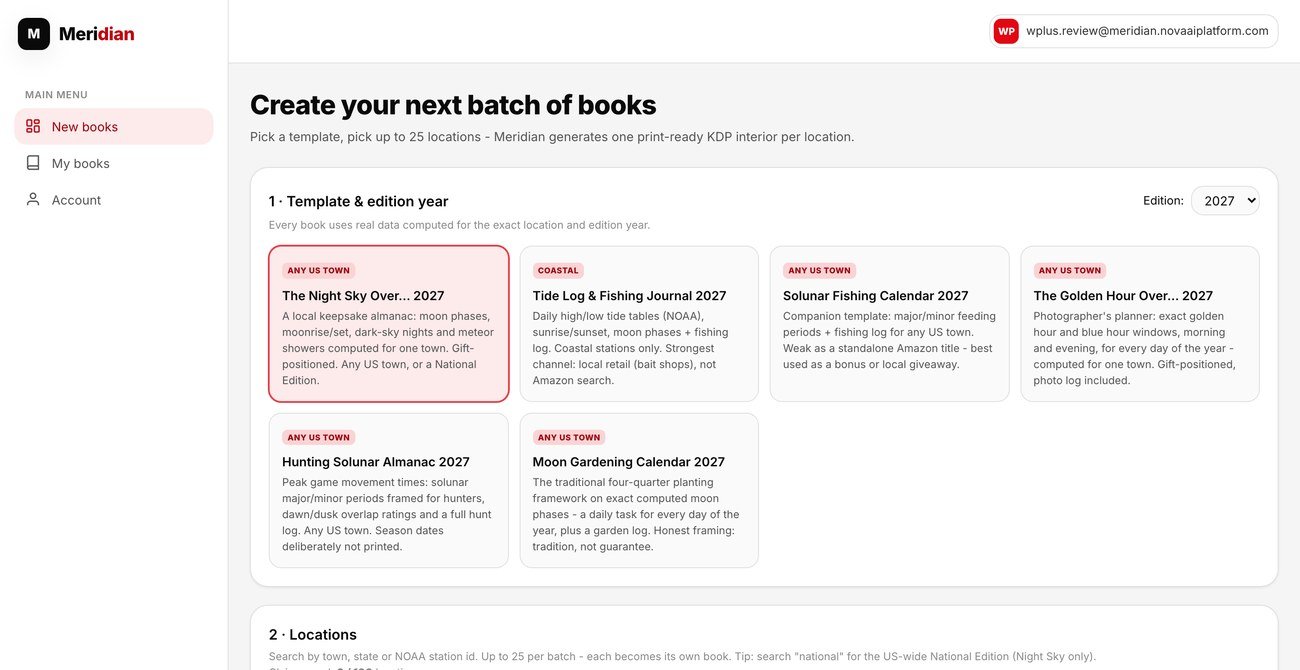
During generation: confirm which template is included in your license and whether it covers that country. Night Sky, Solunar Fishing and Prayer Times have broader geographic support. Weather Year and When to Plant rely on US datasets. The advanced Golden Hour, Tide Log, Hunting and Moon Gardening examples belong to the optional Template Vault.
After download: inspect the entire interior and verify the cover against the actual page count, paper, trim and bleed settings. Review times around local daylight-saving changes, confirm year labels, and inspect generated titles and keywords for misleading claims. If the software produces pages quickly, you can still take the time to ensure they are a book someone would want to own.
Is the 257,000+ Town Claim Accurate?
The supplier’s current public pages promote 257,000+ towns in fourteen countries. Earlier launch-related reviews and offer descriptions cite lower counts, including 107,000+ and a US-focused figure of 24,000+. Because Meridian can update its database, these statements may represent different snapshots or scopes; without accessing its complete inventory, we cannot establish a precise live count independently.
The listed countries are the United States, Canada, United Kingdom, Ireland, Australia, New Zealand, Germany, Austria, Switzerland, France, Belgium, Spain, Italy and Mexico. Language options are marketed as English, German, French, Spanish and Italian, but local environmental datasets are not necessarily available in every combination.
The software says town names, time zones and coordinates use GeoNames data, which is available under attribution requirements. Place-name coverage is different from a verified commercial market for a location. A tiny village with very few residents may technically have a supported coordinate but limited demand for an English-language printed night-sky guide.
Before using one of the 25 product claims, check both whether the precise location is available and whether real customers search for that kind of almanac. In a data book, a correct town lookup is necessary; it is not a guarantee of revenue.
Five Product Templates vs Optional Template Vault
The vendor identifies five templates as part of the basic offer: Night Sky, When to Plant, The Weather Year, Prayer Times and Solunar Fishing. They serve different readers, from stargazers and gardeners to fishing enthusiasts and people seeking local daily prayer schedules.
The optional Template Vault adds four more: Golden Hour for photographers, Hunting Solunar, Moon Gardening and Tide Log. These are not guaranteed entitlements of the product package. The tide-focused template is US-coast-specific because it depends on NOAA predictions.
A core Night Sky book can include moon phase and rise/set data, dark-sky indications and celestial references for a selected locality. A planting edition uses frost and temperature normals rather than daily weather forecasts. A fishing edition is based on solunar timing, not a promise that fish will bite on a particular date.
We would pick one subject and create a useful edited product before investing in another template set. Template counts and formats are not substitutes for accuracy, readable page layout and a real target audience.
The Night Sky Flagship: Location-Specific Astronomy
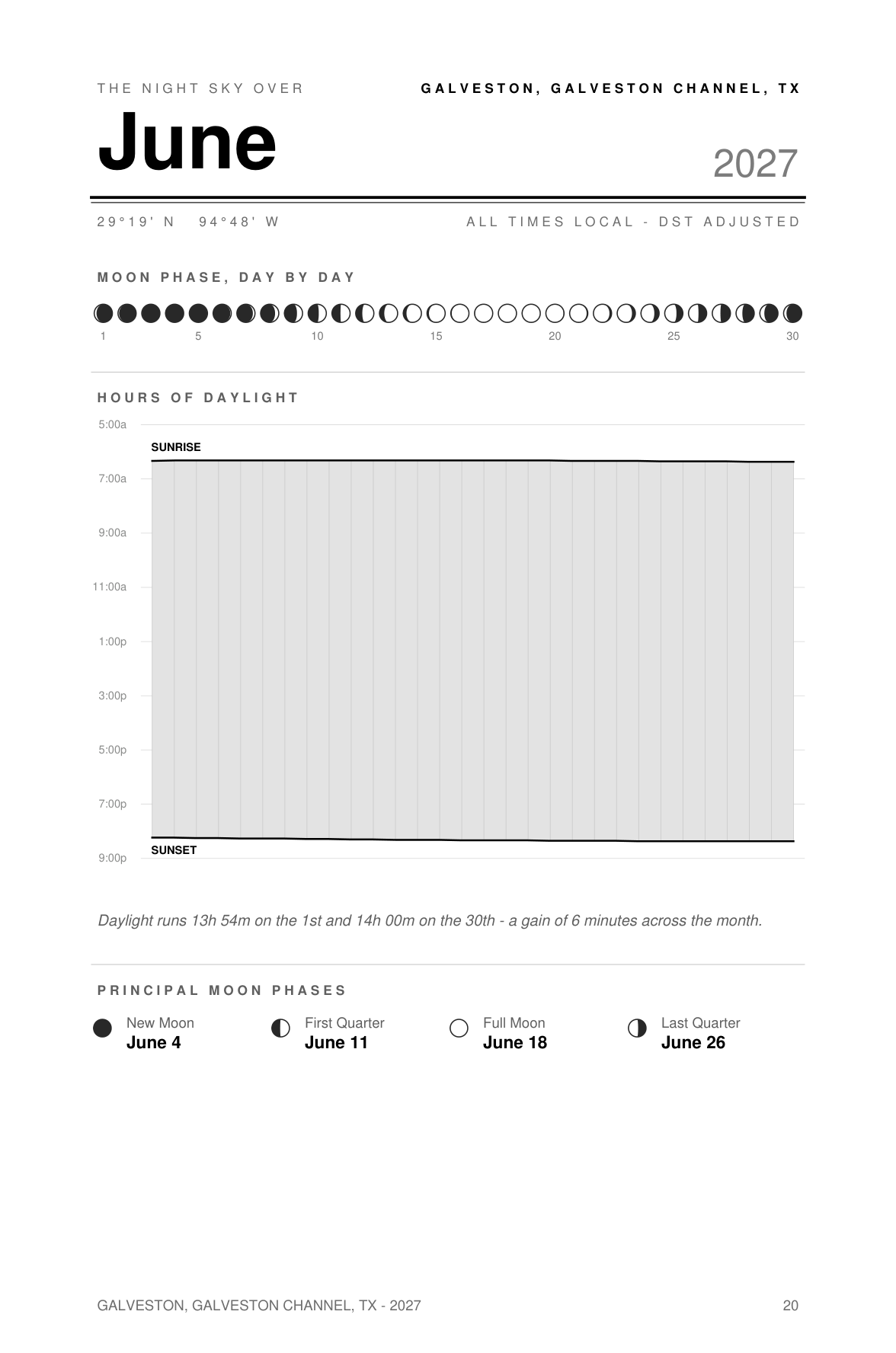
Meridian’s flagship is the Night Sky almanac. The seller promises computed moon phases, lunar rise and set times, illumination, daylight bands and other night-sky planning information for the chosen year and town. Values are said to account for the city’s coordinates, time zone and historical daylight-saving transitions.
Compared with a blank star journal, a correctly calculated local reference book could have genuine value. The same night-sky event is not observed at the same local clock time everywhere, and southern-hemisphere views can look different from northern ones. Local time conversion is particularly important on daylight-saving transition dates.
Still, a calendar of astronomical times is not the same thing as a live observing forecast. Clouds, light pollution, terrain and local regulations can change what a reader can actually see. An author should avoid describing the book as a guarantee of dark skies or perfect meteor-shower visibility.
For a real quality check, compare a sample of sunrise and moonrise values with independent authoritative tables for the same coordinates and year, including dates near the daylight-saving switch. Check whether the year charts and any moon images are correctly labeled. Our research did not perform those calculations, so the vendor’s claims remain unverified here.
Explore Meridian’s current Night Sky and local almanac offer →
What Do You Actually Own When You Claim a Town?
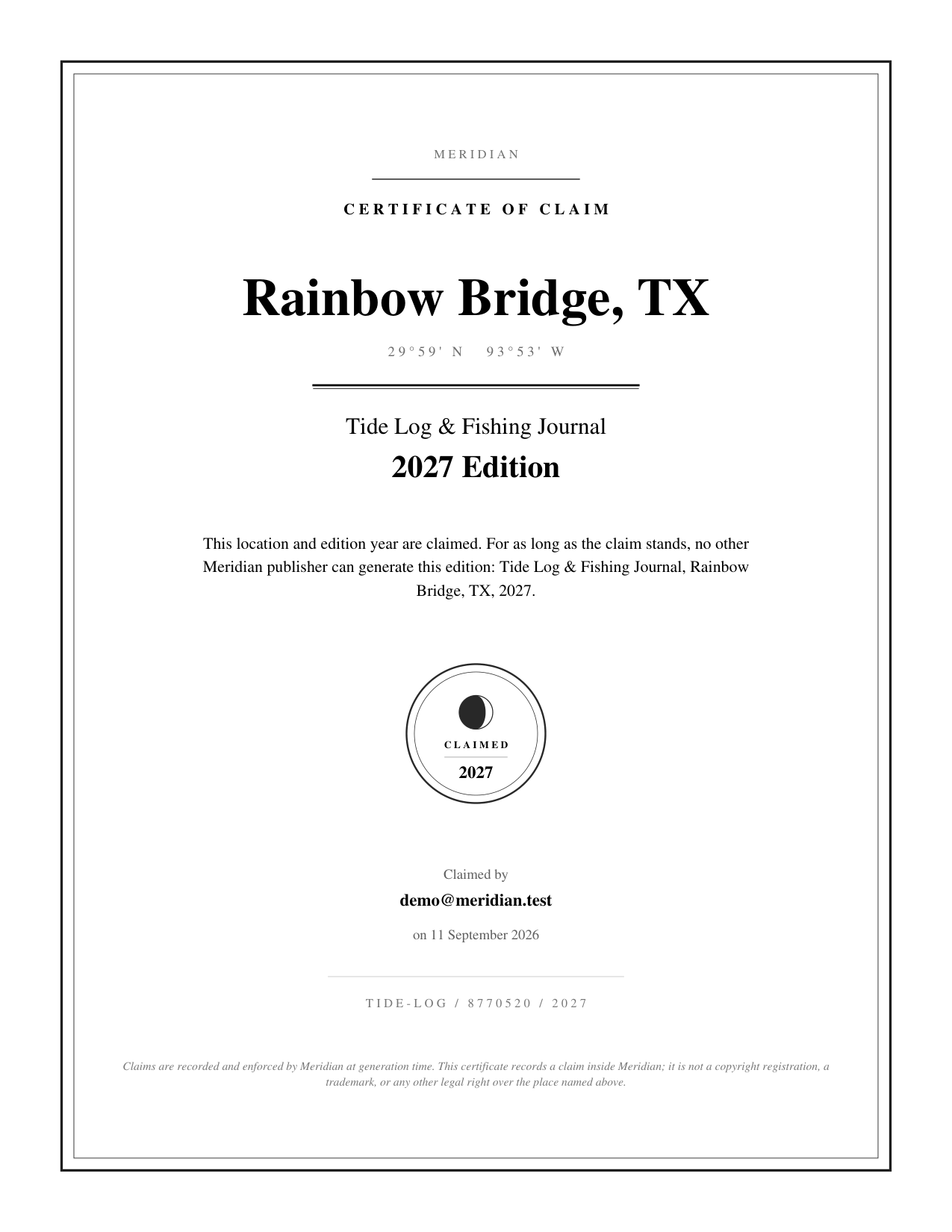
Meridian’s most distinctive selling point is its server-side claiming system. According to the official terms, a claim applies to the combination of a specific template, location, year and language. Once a buyer generates that combination, other Meridian users are prevented from generating the same edition through this particular software. The product advertises 25 claims, and the seller says claiming is first come, first served.
This is not legal ownership of the town, nor a trademark, copyright monopoly or exclusive right to its astronomical data. The seller’s own Terms & Conditions explicitly state that claims do not confer legal or trademark exclusivity outside the platform. A competing publisher can calculate the same publicly available sunset dates and publish an independently created calendar for the same location using another tool.
It is also not “one town, forever.” The same location with a different year, template or language is a separate claim. A Night Sky book for Munich in German is not the same claim as the English edition, and a planting calendar is separate from a night-sky one. Future annual editions require checking the current entitlement; the Annual Editions Club is promoted as an extra.
The official site displays a count of towns supposedly already claimed, but we have not independently examined the seller database or verified the counter’s accuracy. An account-internal reservation may still be useful to reduce exact duplication among the same app’s users, but it should never be marketed as a protected Amazon category or a permanent commercial moat.
What Does the 25-Claim Product Limit Mean?
The entry license includes 25 location-edition claims, as described by the vendor. Each claim corresponds to the four-part combination, not just a town name. Picking a new book language or year for the same place uses another slot. A buyer planning several book series should therefore record claimed combinations before generating them.
The vendor describes up to ten locations per batch for the entry offering and a larger batching capacity under its Publisher Tier. Batch convenience is not permission to ignore KDP’s limits or submit repetitive, low-differentiation titles. The best use of a claim is a real, well-researched product with a plausible customer audience.
For example, a Night Sky almanac for a particular town and year might appeal to a local gift audience, astronomy enthusiasts or people planning an annual tradition. A second local calendar with only a different cover and otherwise identical explanatory material could be less valuable, despite counting as another claim and another listing.
Maintain a simple ledger containing the town, region, exact coordinates, template, year, language, generation date, files and KDP title status. That record can help prevent accidental duplicates, let you proof the correct data and avoid wasting a limited generation entitlement.
The KDP Two-New-Titles-Per-Format Weekly Cap Changes the Business Case
This is a major October 2026 consideration. Amazon’s current Create a Book help page states that an account may create up to two new titles per format each week and separately submit up to two new titles per format for first-time publication each week. The limits reset on Sunday at midnight UTC. Existing already-submitted titles can be updated without consuming a new submission slot.
The change took effect in September 2026, with separate submission restrictions clarified in October. Earlier advice encouraging publishers to generate hundreds of almanacs immediately is therefore less practical. The restriction applies separately to eBooks, paperbacks and hardcovers; it should not be described as two books total across all formats.
For someone producing only new paperbacks, a 25-claim Meridian product would take at least 13 weekly publishing windows if all 25 became new titles, the account used both weekly paperback slots exclusively for these books and no other limits intervened. A 100-claim publishing allowance would take at least 50 weeks to turn into 100 new paperbacks under the same assumption.
These are theoretical minimum release windows, not a guaranteed timetable. Draft creation, file acceptance, quality review, additional restrictions and the time required to proof each book all matter. If the publisher already has novels or other projects competing for paperback slots, local almanacs must share that budget. This is why a high-volume upgrade should be evaluated cautiously.
Amazon KDP Content Quality and Repeated-Book Risk
Meridian argues that computed astronomical and climate data may be more defensible than another AI-written generic journal. That is plausible, but it does not exempt any title from Amazon KDP Content Guidelines and its content-quality policies. Amazon may reject or remove books that disappoint readers, duplicate other available material excessively or present misleading metadata.
Two city almanacs may have different daily sunrise tables but still share most of their cover layout, prose, chapter design and chart structure. Distinct town names alone do not guarantee that each book offers enough individualized value. The publisher needs to evaluate the full customer experience, not merely count different numbers in tables.
The vendor says the almanac data is deterministically computed rather than generated as AI-written prose. That could change which parts of an actual book require AI-generated-content disclosure, but authors must assess the real pipeline, any cover assets and anything they add. KDP distinguishes AI-generated material from AI-assisted production; the owner is responsible for truthful reporting.
A prudent publisher will give each intended market a reason to choose the title, perhaps through carefully researched local context, readable explanations and real usefulness. Never create false associations with local observatories, municipalities, government agencies or astronomical societies.
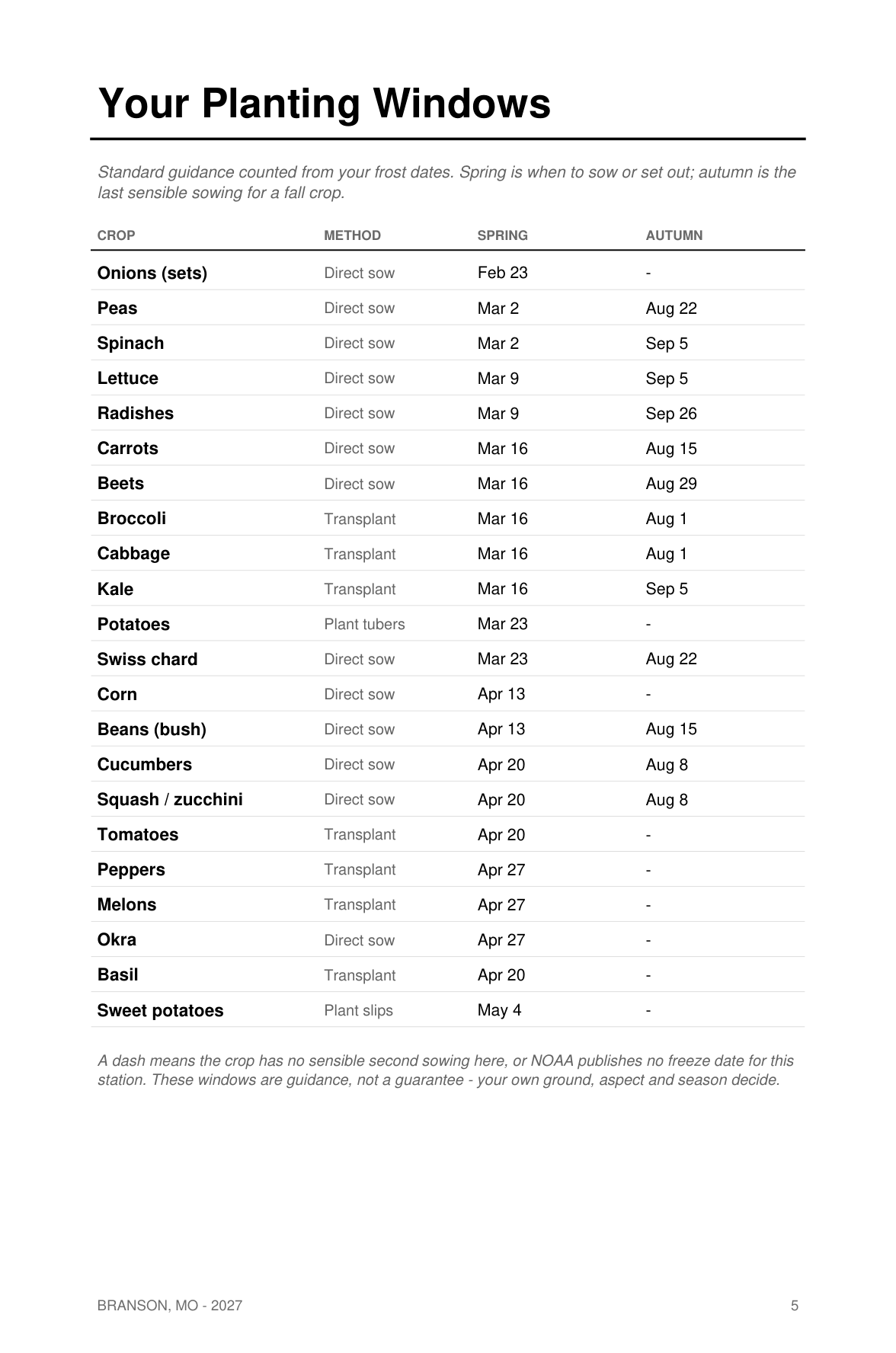
Planting, Weather and Solunar Fishing: Where the Numbers Come From
The seller states that planting and weather templates are built from the US NOAA/NCEI 1991–2020 climate normals. These are historical long-term averages, not predictions of the weather on any future particular day. According to its documentation, Meridian matches a location to a weather station with available data and identifies that station and its distance in the generated book.
Averages can be helpful for gardening planning, but they should not be framed as frost-proof guarantees or safety advice for a particular season. Elevation differences, microclimates, urban effects and climate variability can make station normals less representative of a reader’s actual garden. An editor should verify the station, source vintage, crop guidance and local relevance before publishing.
The Solunar Fishing template promises lunar-based major and minor activity windows and a log. It is a planning tradition, not a proven guarantee that fish will be active at any given minute. Weather, regulations, daylight, habitat and species matter. If another optional Tide Log template is used, NOAA predictions also require correct stations and dates; they do not replace marine navigation guidance.
The seller’s published Disclaimer says computed values and tide predictions are not intended for navigation or any safety-critical use. We agree with that boundary. A responsible book should include appropriate limitations and encourage readers to consult official current advisories where necessary.
Prayer Times: Accuracy and Convention Selection Matter
Meridian’s Prayer Times template is marketed for supported towns in five languages. The vendor says users can select among six calculation conventions and distinguish Standard from Hanafi Asr calculations. This type of localization is more than a cosmetic language change, because different communities use different accepted methods and local practices.
The marketing documents mention conventions including Muslim World League, ISNA, Egyptian, Karachi, Umm al-Qura and UOIF. They also describe a special fallback for certain high-latitude dates and a 65.5-degree latitude limitation for the prayer-time template.
Because these schedules can be used for actual worship, they deserve more careful verification than an ordinary decorative gift calendar. A publisher should compare representative dates and locations with relevant local authoritative timetables, ensure the selected convention is visibly identified and explain any fallback or asterisk markings. We have not checked Meridian’s outputs against a specific mosque or regional calendar.
Do not tell buyers that a generated book is officially approved by religious authorities without evidence. State precisely which calculation convention the book uses and whom it is intended for.

Historical Editions, Time Zones and International Languages
The vendor promotes keepsake editions dating back to 1940 for applicable computed-data templates. That can be attractive as a birth-year gift, provided historical clock rules are applied correctly and the subject is still meaningful for the chosen year. A common source of mistakes is assuming that current daylight-saving rules applied unchanged to a historic date.
Meridian says it uses the selected town’s historical time-zone rules. We have not validated individual years or exceptions. An author considering a 1950 or 1980 edition should check historical local time conventions and a sample date independently, particularly in regions with past changes in offset or daylight-saving adoption.
The current product describes five book languages and localized town names, time formats, decimal marks and book layouts. This can support broader markets, but a language choice in a generator is not equivalent to a professionally translated reference work. The seller itself recommends having a fluent native speaker review sample text before publishing in an unfamiliar language.
Separately, the Annual Editions Club is advertised for future edition-year availability and easier catalog renewal. A prior-year ability and a future-year entitlement are not necessarily identical. Confirm the exact years unlocked by Core before buying with the intention of producing annual updates indefinitely.
6×9-Inch Interior, 140 Pages and Matching Cover: Ready for KDP?
Meridian promises an approximately 140-page 6×9 print-ready interior and a matching full-wrap front, spine and back cover as part of the basic download. It also prepares a suggested title, subtitle, description and seven backend keyword ideas for the listing. These are useful production components because KDP book creation requires both interior and cover files.
But a vendor’s term “print ready” does not mean that Amazon has approved your exact file. Page dimensions, embedded fonts, cover bleed, spine calculation, margins, paper type, chart clarity and image contrast still need to be checked. A print proof can reveal text that looks fine on screen but is too faint or small on paper.
The official JV page says a basic cover is included and that the optional Cover Pack supplies editable source templates for restyling. However, some checkout descriptions may make the cover pack sound necessary for full-wrap covers. The customer should confirm what Core delivers under the live order’s written entitlements before purchasing, especially because refunds are not generally offered.
Descriptions and keyword ideas are drafts, not automatic permission to use misleading claims or trademarks. Review them for the actual edition year, region, language, exact contents and supported data limitations.
Commercial License: Is the Town Claim a Copyright?
Meridian’s official Terms & Conditions describe a single-person or single-business license to use the hosted application for the purchaser’s own publishing business. They prohibit sharing or reselling access credentials and allow the seller to revoke access for specific abuses, including systematic claim squatting intended for resale.
The publisher remains responsible for books produced from the service, including rights and platform compliance. Some source datasets are public domain, while the town names and coordinates use GeoNames under CC-BY attribution. Public-data availability does not convey ownership over factual astronomical phenomena or geography.
Importantly, the town claim certificate is not a copyright registration, trademark certificate or government right over a location. It records an internal database allocation among Meridian customers. Buyers should not describe it as preventing an unrelated competitor from writing a local book with independently computed data.
If a business intends to resell the software itself, grant sublicenses or run accounts for many clients, written permission would be needed beyond what the standard terms establish. The seller does not advertise the product as unrestricted PLR/reseller rights for its hosted application.

Meridian Product Pricing and the Optional Funnel
The current seller and original September 2026 JV pages display a $17 one-time product price. That is a public marketing reference, not a guarantee of the actual amount charged by WarriorPlus when you click today. Check the checkout carefully, including any optional bump or upgrade offer, before purchasing.
The funnel’s extras include an editable Cover Pack, the Template Vault’s additional data-book types, a Publisher Tier with increased claims and batching, and an Annual Editions Club focused on future editions. The published JV material confirms these as separate steps. This consumer review intentionally does not list the numeric prices of any bump or upsell.
The Publisher Tier’s higher claim allowance may be attractive for a large market map, but Amazon’s new two-title-per-format weekly limit makes rapid bulk publishing less realistic. The Annual Editions Club could be more useful to a publisher who has a successful proven title and wishes to publish subsequent annual editions; it should not be bought on assumptions about unlimited instant catalog release.
Consider a narrow test: one location with an audience, one template, one book proof, then a measured launch. Without reliable demand data and a high-quality result, buying access to many more possible books may simply create unused capacity.
Refund Policy: All Sales Final, With a Terms-Page Inconsistency
The vendor’s dedicated Refund Policy, labeled last updated August 2026, states that all sales are final and no refunds are offered. It explains that generated PDF files, covers, listing copy and server-side claims cannot be returned. It directs buyers with technical problems to support for fixes, rather than offering a routine change-of-mind refund.
There is an inconsistency worth identifying: the general Terms & Conditions page contains an opening sentence mentioning a “guarantee window” for refund requests, whereas the dedicated Refund Policy explicitly denies refunds. We would not interpret that stray sentence as a valid, unconditional guarantee. Confirm the specific WarriorPlus checkout and ask the seller for written clarification before purchasing if refund eligibility matters.
Mandatory legal consumer protections or payment processor protections may still apply in particular circumstances. We have not purchased Meridian or tested a refund request. Save a copy of the checkout terms and all communications if you proceed.
The seller also states that chargebacks may revoke access and release existing location claims. That is a material contractual consequence to understand, while any legally available dispute rights must be assessed independently.
Check Meridian’s current features, 25 claims and checkout conditions →
Meridian vs Other KDP Generators
Meridian differs from creative-story software because its central asset is time-and-place-dependent numerical information. Our QuestBook AI review discusses children’s branching stories, while Shigai Royalty and Cluevora concentrate on logic puzzles and mystery books.
That specialization may make Meridian more attractive to publishers interested in local reference data, planners and keepsakes. It does not prove that its books are more profitable or more likely to be approved than the creative alternatives. The costs of verifying astronomical or regional calculations may be significant even if the software produces pages quickly.
All these publishing tools share two responsibilities: compliance with Amazon KDP’s current restrictions and delivering a genuinely useful reader experience. A differentiated product concept is not the same as a differentiated high-quality final book.
Who Should Consider Meridian?
Potential fit: a publisher who knows a specific geographic audience, wants a localized almanac gift or reference title, and is prepared to proof the calculations, format and customer experience. A person with an existing website, regional newsletter or local business channel may have more viable distribution options than someone relying exclusively on organic Amazon search.
Weak fit: anyone expecting legally exclusive rights to a town, a no-refunds trial, fast unlimited book publishing, guaranteed revenue, or fully automated data validation. A buyer whose main goal is a general children’s adventure story or conventional novel is looking at the wrong category of software.
A successful local title should be evaluated using real demand, honest product descriptions, reader feedback, printing costs and settled sales. Producing the PDF is only one stage of the business. The value of location-specific information will depend on whether people care about that particular place and edition.
Meridian Review: Pros and Cons
| Potential strengths | Material limitations |
|---|---|
| Focused data-book concept with locality-specific numeric tables | Data accuracy and quality not independently verified in this review |
| Five advertised Core templates and multilingual world editions | Planting/weather remain US-specific and other themes are upsells |
| 140-page 6×9 interior, cover and listing drafts in one workflow | Actual KDP compliance still depends on file proofing and policies |
| Server-side claim reduces duplicates among Meridian users | No legal exclusivity and no restriction on other publishers |
| Twenty-five product combination claims | Every new year/language/template combination consumes another claim |
| Historical editions and local time calculations advertised | Historical DST conventions and source values need spot checks |
| One-time product price marketed | Refund Policy explicitly says all sales final |
| Publisher-focused export and batching options | KDP creation/submission limits restrict rapid catalog scaling |
Meridian Review Verdict: Interesting Data Tool, Limited Exclusivity
Meridian offers a distinct concept compared with generic AI book factories. For an author who needs a carefully formatted, location-specific reference almanac, the combination of computed dates, calendars, cover layout and metadata drafts might reduce technical production work. The browser workflow and included Night Sky template are plausible starting points for a real local-interest book.
The headline should not be taken literally. Competitors can create books about the same towns using independently sourced information. Meridian’s claim system only restricts use of Meridian itself for an identical combination, and it does not guarantee trademark or copyright protection. The seller’s own license and policies make that clear.
The most significant commercial restraint is Amazon KDP’s current cap on new title creation and first submission. Access to 25 or 100 possible editions does not translate into the ability to list them all quickly. Content that looks substantially the same across many books can also face quality problems. More is not automatically better.
Our view is to assess one well-chosen, well-proofed local book and one marketplace niche before increasing claims or buying optional packs. We would not rely on unverified scarcity counters, guaranteed “best seller” assumptions or a refund that the seller’s dedicated policy does not offer.
Meridian Frequently Asked Questions
What does Meridian actually generate?
A seller-advertised local data-book package with a roughly 140-page 6×9 interior, matching cover, listing copy, keywords and internal claim certificate.
Can nobody else publish about my town?
No. A claim prevents other Meridian accounts generating the exact template/town/year/language combination. Independent publishers can publish for the same city.
How many claims are included?
Twenty-five combination claims are advertised for the product. Each language, template or year variation can be a different claim.
How many towns and languages are available?
The seller now advertises 257,000+ places across 14 countries and five languages. Coverage varies by template and was not independently counted.
What templates are included in Core?
Night Sky, When to Plant, The Weather Year, Prayer Times and Solunar Fishing. Other advertised book types are in the optional Template Vault.
Does Meridian include a full-wrap cover?
The vendor’s FAQ and JV page say a basic generated cover is included. The separate Cover Pack is described as editable source templates; confirm final checkout wording.
How far back can a historic keepsake edition go?
The seller advertises past-year editions back to 1940 for applicable computed-data templates. Confirm the actual licensed year range.
What is the current price?
The seller markets a $17 one-time product reference; WarriorPlus checkout controls the real amount.
Does it offer refunds?
The dedicated vendor Refund Policy says all sales are final. Its general Terms page contains conflicting language, so seek written clarification if relevant.
Can I publish 100 paperbacks immediately?
No. Amazon KDP currently limits new title creation and first submissions to two per book format each week, resetting Sunday 00:00 UTC.
Will Amazon approve every generated almanac?
No. Paperback file preparation, originality, accuracy, KDP content quality and metadata all remain the publisher’s responsibility.
Are the astronomy and climate values guaranteed?
No. The vendor says it uses algorithms and public datasets; we have not independently verified a complete book. Weather and solunar predictions are not safety advice.
Are optional OTO prices disclosed?
No. This review lists only the product reference and describes upgrades by function, not by optional prices.
Will the books earn passive royalties?
Income, search rankings and sales are never guaranteed. Many local-interest titles may sell modest volumes, according to the seller’s disclaimer.
Check the Current Meridian Offer
If you want a localized data almanac for an identified niche, investigate the Core package with its five advertised templates and 25 account-internal claims. Check your town’s availability, review the current license and refund terms, and make sure you understand the present KDP weekly publishing limits before considering any optional capacity upgrades.
The button below uses our authorized WarriorPlus affiliate destination for Meridian. This is not legal ownership of a city, exclusive rights outside the vendor platform or a guarantee of sales.
View Meridian on WarriorPlus — Check Current Terms →
Research basis as of October 15, 2026: official Nova AI Platform Meridian sales and JV presentations, Meridian Terms & Conditions, Refund Policy and Disclaimer (the three seller documents were reviewed but are intentionally not linked directly), plus Amazon KDP’s current Create a Book title-creation and submission limits, Content Guidelines and Content Quality guidance linked above. We have not run a licensed Meridian account, verified scientific values or independently audited its location-claim database. Seller income and scarcity claims are not presented as independently established facts.
Advantages & limitations
Advantages
- Location-specific computed-data book concept differs from generic blank journals
- Five distinct product almanac templates for different interests
- Advertised 140-page PDF, matching full-wrap cover and listing copy packaging
- Five languages and many supported towns in Europe and North America
- Historical local-time handling and flexible dedication pages advertised
- In-platform claim system may reduce exact duplicate output among Meridian accounts
- One-time product price marketed
Limitations / unknowns
- No exclusivity outside Meridian: third-party authors may publish the same town and datasets
- Amazon KDP limit of two new book titles created and submitted per format each week restricts scale
- 25 product claims are template/town/year/language combinations, not entire permanent cities
- Too-similar interiors may create customer-experience or KDP review issues
- Astronomical and NOAA data quality not independently audited
- Official vendor Refund Policy says all sales final; Terms has contradictory clause
- Optional extra book templates, increased claim capacity and annual editions are separate purchases
- Publishing, proofing, metadata and marketing still the customer's responsibility
- No proven typical sales or profit outcome
Ready to explore Meridian?
See current features, package terms, licensing and refund details on the vendor website. This review does not guarantee availability or outcomes.
Sponsored link authorized by the publisher; affiliate tracking and merchant checkout conditions have not been independently verified.