A child’s room can shift from tidy to chaotic in minutes, especially when blocks, dolls, books, puzzles, craft supplies, and stuffed animals all compete for the same floor space. The good news is that effective toy storage ideas do not require a huge room or an expensive makeover. A practical system simply needs to make toys easy to see, easy to reach, and easy to return.
The most useful toy storage ideas reflect the way children actually play: everyday favorites stay at child height, categories remain simple, and every item has an understandable home.
This guide covers ten realistic toy storage ideas for bedrooms, playrooms, shared family spaces, and small homes, with options that can adapt as children grow.
Why Simple Toy Storage Ideas Work Better
The goal is not to fit the greatest possible number of containers into a room. The goal is to create a system that children and adults can understand at a glance. Complicated categories often fail because nobody wants to sort twenty small pieces into twenty precise places at the end of the day.
Use broad groups such as building toys, vehicles, pretend play, art supplies, puzzles, and soft toys. A small “favorites” or “mixed play” bin can catch items that do not fit an obvious category.
Good toy storage ideas also leave breathing room. Overfilled containers are hard to search and often encourage children to dump everything out. Open capacity makes cleanup easier and allows space for occasional additions.
10 Toy Storage Ideas That Are Easy to Maintain
1. Start with Low, Open Bins
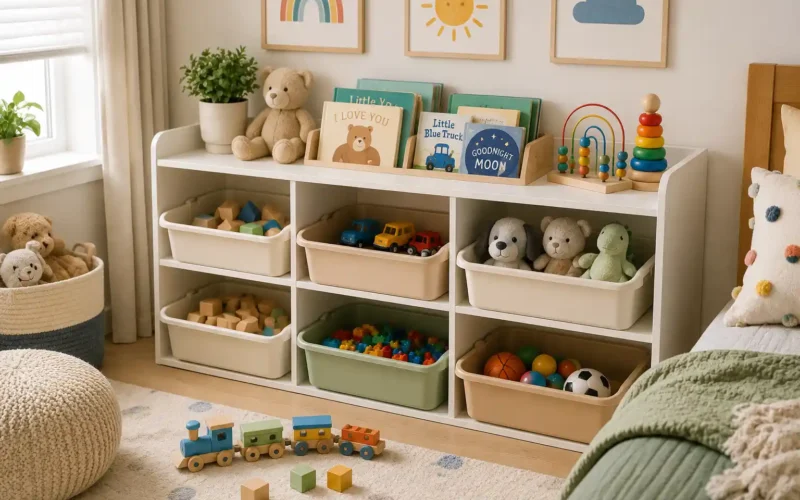
Low, open bins are one of the most practical toy storage ideas for younger children because they make both choosing and returning toys simple. A child can see the general category without opening lids, pulling out heavy drawers, or asking an adult for help.
Place frequently used toys in the easiest positions. Heavier items should stay in lower bins, while lighter collections can go slightly higher.
Open bins work well for blocks, toy animals, vehicles, and dress-up accessories. Smaller parts can sit in a shallow insert inside the main bin.
Do not overfill the bins. A container that is roughly three-quarters full is usually easier to search and easier to clean up than one packed tightly to the edge.
2. Create Simple Activity Zones
Instead of organizing only by object type, arrange the room around activities. This turns the storage plan into a layout that supports play as well as cleanup.
A reading zone might include books and a small basket for current favorites. A building zone can keep blocks and vehicles near clear floor space, while an art zone keeps washable supplies near a table.
Activity zones keep toys near where they are used, so cleanup becomes a quick reset rather than a trip across the room.
In a shared bedroom, give each child one personal shelf or bin while shared toys remain in the central play area.
3. Rotate Toys Instead of Displaying Everything
Toy rotation is one of the most effective toy storage ideas for reducing visible clutter without getting rid of useful toys. Keep a manageable selection available and store the rest in a labeled adult-access area.
A rotation needs no strict calendar. Change the selection when interest drops or the room becomes difficult to reset; returning toys often feel fresh after time out of sight.
Keep complete sets together, and add a short inventory note to each rotation box so puzzles and construction pieces do not disappear into long-term storage.
Toys ignored across several rotations may be ready for donation, resale, repair, or recycling.
4. Use Picture-and-Word Labels
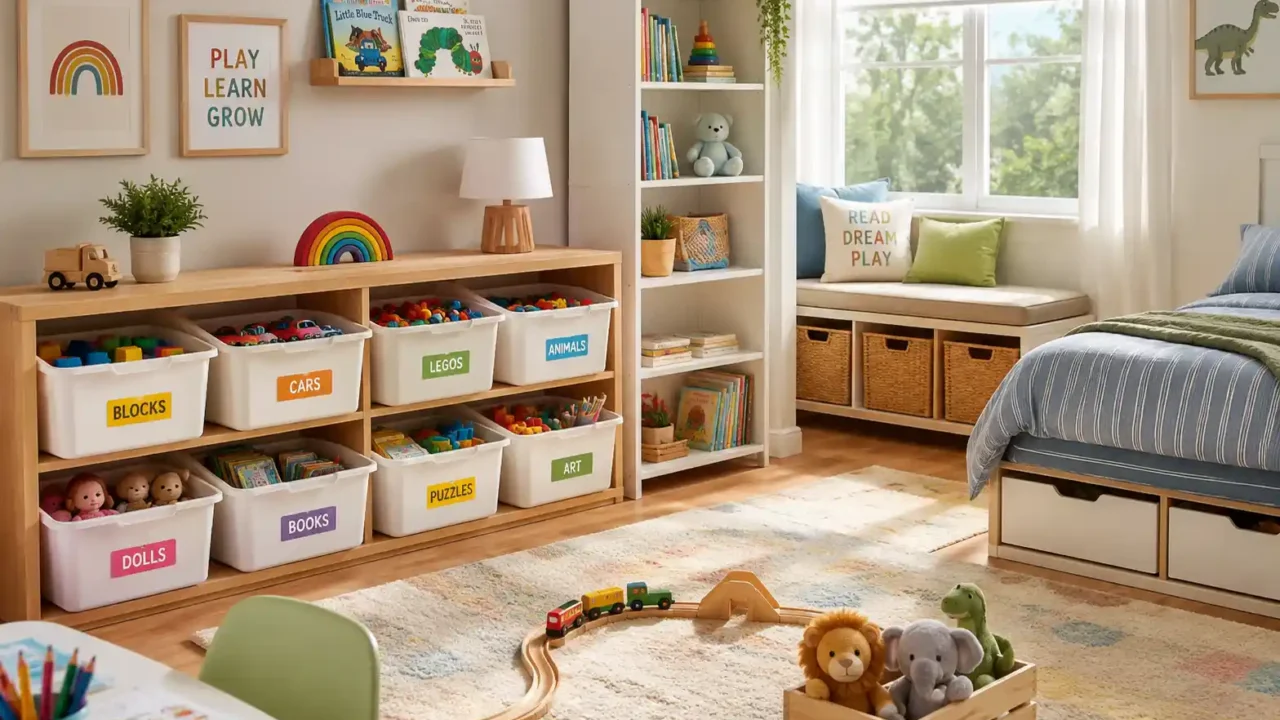
Labels help turn toy storage ideas into a system that children can follow independently. For younger children, use a clear picture together with a simple word. Older children may only need text.
Keep labels broad. “Cars” is easier to manage than several vehicle subcategories; the label should support cleanup, not create a catalog.
Place labels where children can see them from their normal height. They can be printed, drawn by hand, or slipped into a clear holder.
Let children help name the categories. Their logic may differ from an adult’s, but it is often easier for them to remember.
5. Make Safe Use of Vertical Space
Vertical storage can free valuable floor area, especially when you need toy storage ideas for small spaces. Wall-mounted shelves, tall cubbies, and over-door organizers can all help, but the placement should reflect who needs access.
Keep everyday toys within comfortable reach. Use higher shelves for display items, rotation boxes, sentimental toys, or adult-supervised materials. Avoid placing exciting toys high enough to encourage climbing.
For tall shelves or cubby units, review the safety guidance from the U.S. Consumer Product Safety Commission and follow the furniture manufacturer’s anchoring instructions. The campaign emphasizes securing furniture with drawers, doors, and shelves to the wall to help prevent tip-over injuries.
Avoid overloading vertical storage. Give each shelf a clear purpose and leave enough open space to keep the room visually calm.
6. Add Storage Under the Bed
The area beneath a bed can provide useful capacity without taking away play space. Shallow rolling drawers, soft zippered bags, or low containers can hold rotation toys, puzzles, building sets, dress-up clothes, or seasonal items.
Among toy storage ideas for small rooms, under-bed storage is most successful when each container has one broad category. A single oversized box filled with unrelated items may become another clutter zone that is difficult to search.
Choose containers that move easily and do not catch on flooring. Children should be able to pull them out without trapping fingers or lifting excessive weight.
Keep everyday toys near the outer edge and less frequent items deeper under the bed.
7. Give Books and Display Toys Their Own Area
Books, completed models, favorite figures, and special creations often need a different treatment from everyday loose toys. Giving them a separate area prevents them from being crushed in deep bins and adds personality to the room.
Front-facing ledges keep book covers visible, while a small shelf can display a limited number of favorite models or collectibles.
These storage choices also show the difference between toys ready for active play and items that deserve more careful handling.
Limit display items so the shelf stays meaningful. When something new is added, choose an older item to store, dismantle, or return to play.
8. Use Portable Caddies for Small Collections
Portable caddies are useful for art supplies, building pieces, dolls’ accessories, play food, and other collections that move between rooms. They keep related items together while allowing play to happen at a table, on the floor, or in a shared living space.
For practical toy storage ideas in a living room, a handled caddy can be easier to manage than several small containers. At cleanup time, the entire collection returns to one shelf or cabinet.
Keep the weight reasonable and separate sharp, messy, or adult-supervised materials from everyday child-access items. A removable insert can divide crayons, stickers, or small figures without creating too many categories.
Portable storage lets toys enter a family space for play and leave again without a permanent visible setup.
9. Choose Furniture That Hides Visual Clutter
Some families prefer open storage because it supports independence. Others need at least one place where visual noise can disappear. A balanced room can use both.
Benches, cabinets with child-safe doors, and low units can hold larger collections. Consider how doors, drawers, hinges, or lids move and whether the piece suits the child’s age.
These approaches are particularly useful in shared spaces. One closed cabinet can hold incomplete projects or rotation containers, while a smaller open area remains available for daily favorites.
For a product-focused look at organizer styles, bin layouts, and practical buying considerations, read our guide to choosing a toy storage organizer for a kids’ room before selecting a permanent unit.
10. Build a Five-Minute Cleanup Station
The final idea is a routine supported by the room. Place a small “return” basket near the main play area for toys that belong elsewhere or need sorting later.
A short cleanup can happen before dinner, bedtime, or a new activity. Use one sequence: books first, large toys second, small pieces third, and misplaced items into the return basket.
This is one of the most sustainable toy storage ideas because it accepts that perfect sorting is not always realistic. The return basket prevents a few uncertain items from stopping the entire cleanup.
Empty the basket regularly so it does not become permanent storage. Adults can help with items that need repair, missing pieces, or a decision about donation.
Match Toy Storage Ideas to the Child’s Age
A storage system should change as children grow. Toddlers need broad categories and lightweight containers; preschoolers can use picture labels; school-age children may manage more specific collections and personal display areas. For another practical way to simplify everyday routines, our guide to choosing a kids lunch box for school covers useful features for busy families.
Observe the room before changing everything. Bins that are always dumped or ignored may be too high, too full, too complicated, or too far from where play happens.
The best toy storage ideas support independence without expecting children to maintain an adult-designed system perfectly. A setup that works most days is more valuable than a beautiful arrangement that collapses after one afternoon.
Adapt the System for Small or Shared Rooms
In a compact bedroom, prioritize floor space. Use low units along one wall, under-bed containers, a portable caddy, and limited vertical storage rather than filling every surface.
In a shared room, give each child one personal bin or shelf, then create shared categories for common toys. Color-coded labels can help without requiring separate furniture. When floor space is limited, a well-chosen laundry hamper for small spaces can also keep clothing from competing with toys for the same valuable area.
For toy storage ideas in a living room, choose containers that are easy to carry and simple to close. A limited daily selection can remain accessible, while rotation toys stay in another location. The objective is not to erase every sign of children from the room, but to make transitions between play and family use easier.
Common Toy-Storage Mistakes to Avoid
First, do not buy containers before sorting. Measure the space and review the toy categories so the storage fits both the room and the collection.
Second, avoid too many categories. Start broad, then divide only collections that genuinely need separation.
Third, keep only independently usable items at child height. Adult-supervised materials, fragile creations, and rotation stock belong elsewhere.
The fourth mistake is ignoring empty capacity. Even strong toy storage ideas fail when every shelf and bin is already full. Keep enough open space for easy searching, quick cleanup, and occasional new items.
The fifth mistake is treating organization as permanent. Review the system every few months as children grow and interests change.
Final Thoughts
A successful play space does not need to look perfect throughout the day. It needs to support play, reduce frustration, and make resetting the room achievable. Start with one problem area, choose broad categories, and place the most-used toys where children can manage them.
The most effective toy storage ideas combine access, safety, flexibility, and a simple cleanup routine. Open bins may work for daily favorites, closed storage can calm shared spaces, and rotation can prevent overcrowding without forcing immediate decisions about every toy.
Choose the toy storage ideas that match your room, your child’s age, and the way your family lives. A system that children understand and adults can maintain will always be more useful than one designed only to look tidy.