A portable power bank for travel and daily use can be one of the smallest purchases that prevents the biggest inconvenience: a dead phone when you need maps, tickets, calls, photos, payment apps, or work messages. The best choice is not always the largest battery or the fastest advertised charger. It is the model that fits your real routine, your devices, your bag, and your safety expectations.
Before you buy, think about how often you are away from a wall outlet. A commuter who only needs an emergency phone boost may need a very different portable power bank for travel and daily use than someone who works from airports, uses wireless earbuds all day, or takes weekend trips with a phone, tablet, camera, and smartwatch. The goal is to choose a portable power bank for travel and daily use that solves a predictable problem instead of adding another random gadget to your drawer.
Why capacity matters, but not in isolation
Capacity is usually listed in mAh, and it is the first number most shoppers compare. A 5,000 mAh charger is slim and light, a 10,000 mAh charger is a practical everyday middle ground, and a 20,000 mAh charger can support longer days or multiple devices. However, a portable power bank for travel and daily use should be judged by usable output, not only the number printed on the product page.
No power bank transfers every bit of stored energy into your phone. Some energy is lost during voltage conversion, heat, cable resistance, and charging management. That is why a 10,000 mAh model will not always charge a 5,000 mAh phone exactly two full times. For most buyers, the smart move is to choose a capacity range that gives comfortable margin without making the charger too heavy to carry.
If you are upgrading your phone soon, pair this decision with best phone accessories to buy before your next smartphone upgrade so your charging setup fits the device you plan to use next.
The practical sweet spot for most people
For everyday carry, a 10,000 mAh portable power bank for travel and daily use is often the safest starting point. It is usually compact enough for a small bag, powerful enough for one or two phone top-ups, and less annoying to carry than a brick-sized battery. It also tends to be affordable, widely available, and compatible with most modern charging needs.
A 5,000 mAh model makes sense when size matters more than backup time. It is useful for nights out, short commutes, concerts, or emergency use. A 20,000 mAh model makes sense for long flights, road trips, remote work days, and family use, but it can become too bulky for people who already carry a laptop, water bottle, headphones, and other accessories.
The right portable power bank for travel and daily use is the one you will actually bring with you. A huge charger left at home has less value than a smaller charger that lives in your backpack.
Charging speed and USB-C support
Charging speed matters when you only have 20 minutes between meetings or flights. Look for USB-C output, USB-C input, and clear wattage details. Many shoppers focus on capacity and forget that a slow output can make a power bank feel outdated even when the battery is large.
For modern phones, USB-C Power Delivery is a useful feature. It helps compatible devices charge faster and more efficiently. A portable power bank for travel and daily use does not need extreme wattage for basic phone charging, but 18W to 30W is a practical range for many phones. If you plan to charge a tablet or small laptop, look at higher wattage models and confirm your device requirements before buying.
Cable quality also matters. A good charger can perform badly with a weak cable. If your desk setup includes multiple devices, laptop accessories for desk setup can help you think about charging cables, adapters, stands, and organization as one system instead of separate purchases.
Size, weight, and carry comfort
A power bank is only useful if it fits your daily movement. A slim model can slide into a pocket or small sling bag. A larger model may be better for travel but annoying for everyday errands. When choosing a portable power bank for travel and daily use, check dimensions, weight, and shape, not just capacity.
Rounded edges can make a charger easier to hold with a phone. A flat rectangular design packs well in a backpack. A built-in cable can reduce clutter, but it can also become a weak point if the cable wears out. Magnetic wireless models can be convenient, but they may charge slower or generate more heat than wired charging.
For packing comfort, travel backpack for weekend trips is a useful companion read because a charger is only one part of a practical travel carry system.
Safety features to look for
A safe portable power bank for travel and daily use should clearly list protections such as overcharge protection, short-circuit protection, temperature control, and certified battery cells or safety testing where available. Avoid vague listings that promise unrealistic capacity, extreme charging speed, and premium quality without brand details, specifications, or reviews.
Check whether the product page gives watt-hour information, especially if you fly often. For air travel, FAA lithium battery guidance is worth checking because it explains carry-on rules, watt-hour limits, and how to keep spare lithium batteries protected.
Do not buy a charger only because it is the cheapest option. A low-quality battery accessory can damage devices, fail quickly, or create unnecessary safety risk. A reliable portable power bank for travel and daily use should feel like a safety tool, not a gamble.
For travel buyers, a portable power bank for travel and daily use should also have markings and specifications that are easy to read before you reach airport security.
How many ports do you really need?
A single-port charger is enough for many people, especially if it supports fast USB-C output. Two ports are useful when you want to charge a phone and earbuds, a phone and smartwatch, or two phones at the same time. Three or more ports can be helpful for family travel, but they often increase size and cost.
The important detail is shared output. Some power banks advertise high wattage, but that number may drop when multiple devices are connected. If you need to charge two devices at once, read the output table carefully. A portable power bank for travel and daily use should be predictable under real conditions, not impressive only in headline specs.
If your everyday devices include earbuds, how to choose wireless earbuds for work, travel and everyday use can help you match battery life, charging case needs, and travel convenience.
Display, indicators, and small convenience features
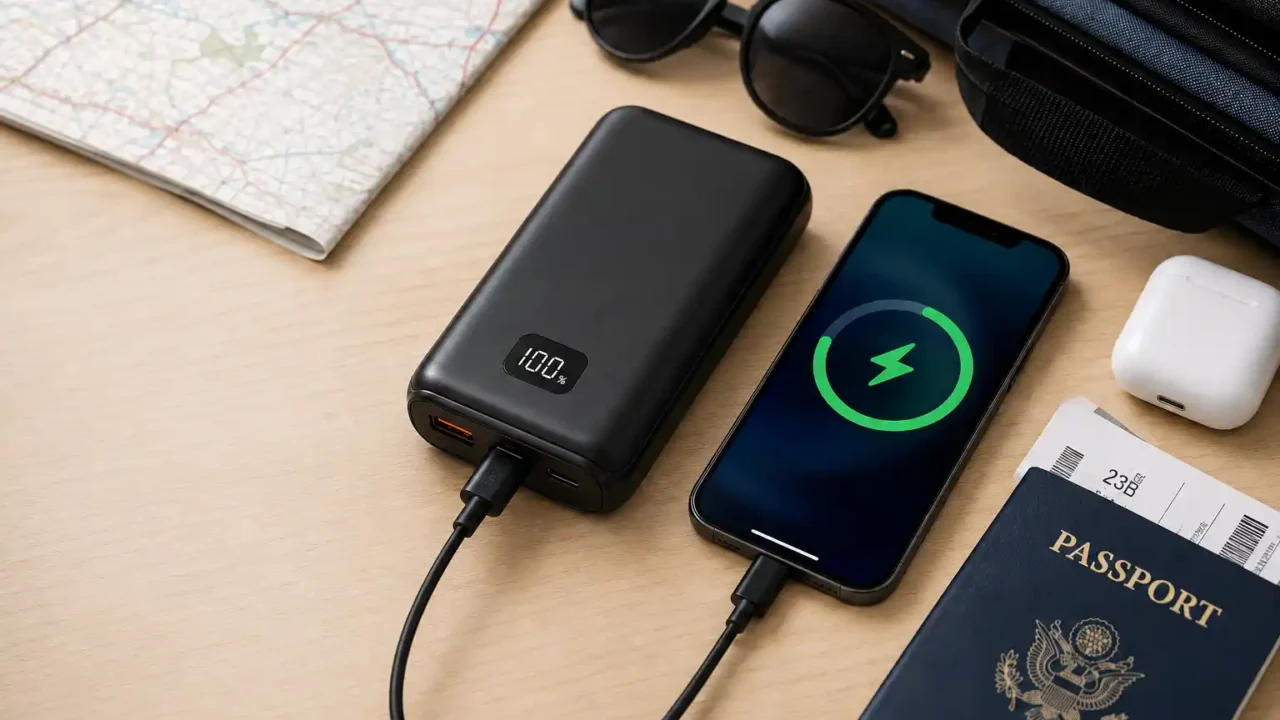
Basic LED dots are enough for some users, but a percentage display can be more useful if you rely on your charger for work or travel. It helps you know whether the bank is ready before you leave home. Some models also show charging wattage, which is useful for people who like to confirm fast charging is working.
Pass-through charging can be convenient because it lets the power bank and a device charge from one wall adapter. However, not every model handles this well, and some brands warn against using it heavily. Treat it as a convenience feature, not the main reason to buy.
A flashlight can be useful for camping or emergencies, but it should not outweigh battery quality, port selection, safety features, and charging performance. The best portable power bank for travel and daily use keeps the core job simple: reliable backup power when your device needs it.
When a deal is actually worth it
Power banks are often discounted, but a deal is only useful if the model fits your devices and routine. Before buying, compare capacity, wattage, ports, cable requirements, weight, warranty, and recent reviews. A cheap charger with poor output or unclear safety information is not a smart bargain.
This is where how to spot a useful online deal before you buy becomes relevant. The same rule applies here: a discount should support a real need, not create a random purchase.
A good portable power bank for travel and daily use should answer three questions clearly: how much backup power you get, how quickly it charges your devices, and whether it is safe and convenient enough to carry often.
Buyer checklist before you choose
Use this checklist before adding a model to your cart:
- Choose 5,000 mAh for light emergency use.
- Choose 10,000 mAh for balanced everyday carry.
- Choose 20,000 mAh for longer travel days or multiple devices.
- Look for USB-C input and output.
- Check wattage, not just capacity.
- Confirm safety protections and clear specifications.
- Check weight and dimensions.
- Look for strong recent reviews, not only high star ratings.
- Confirm airline and destination rules before flying.
- Make sure your charging cable supports the speed you expect.
A portable power bank for travel and daily use should make your day easier, not add another bulky item you regret carrying. Keep the purchase practical and match it to your actual behavior.
Common mistakes to avoid
The first mistake is buying too much capacity. A huge charger sounds impressive, but it may become a drawer item if it is too heavy. The second mistake is buying too little capacity. A tiny charger may look sleek but fail to provide enough backup during a long day.
The third mistake is ignoring wattage. Capacity tells you how much energy the charger stores; wattage tells you how quickly it can deliver power. The fourth mistake is ignoring the return policy. Battery accessories can vary in real performance, and a clear return window matters.
Finally, do not assume every portable power bank for travel and daily use is automatically suitable for every flight, every airline, or every country. Rules can differ, and batteries should always be packed and handled carefully.
Final thoughts
A smart portable power bank for travel and daily use is not about buying the biggest battery on the shelf. It is about balancing capacity, speed, portability, safety, and real-world convenience. For most shoppers, a trusted 10,000 mAh USB-C model with clear wattage and safety information is the best place to start.
If you travel often, work from different locations, or rely heavily on your phone, a portable power bank for travel and daily use can become one of your most important everyday accessories. Choose one that fits your routine, check the details before you buy, and keep it charged before the moments when you need it most. A practical portable power bank for travel and daily use is the one that disappears into your routine until the exact moment it saves the day.