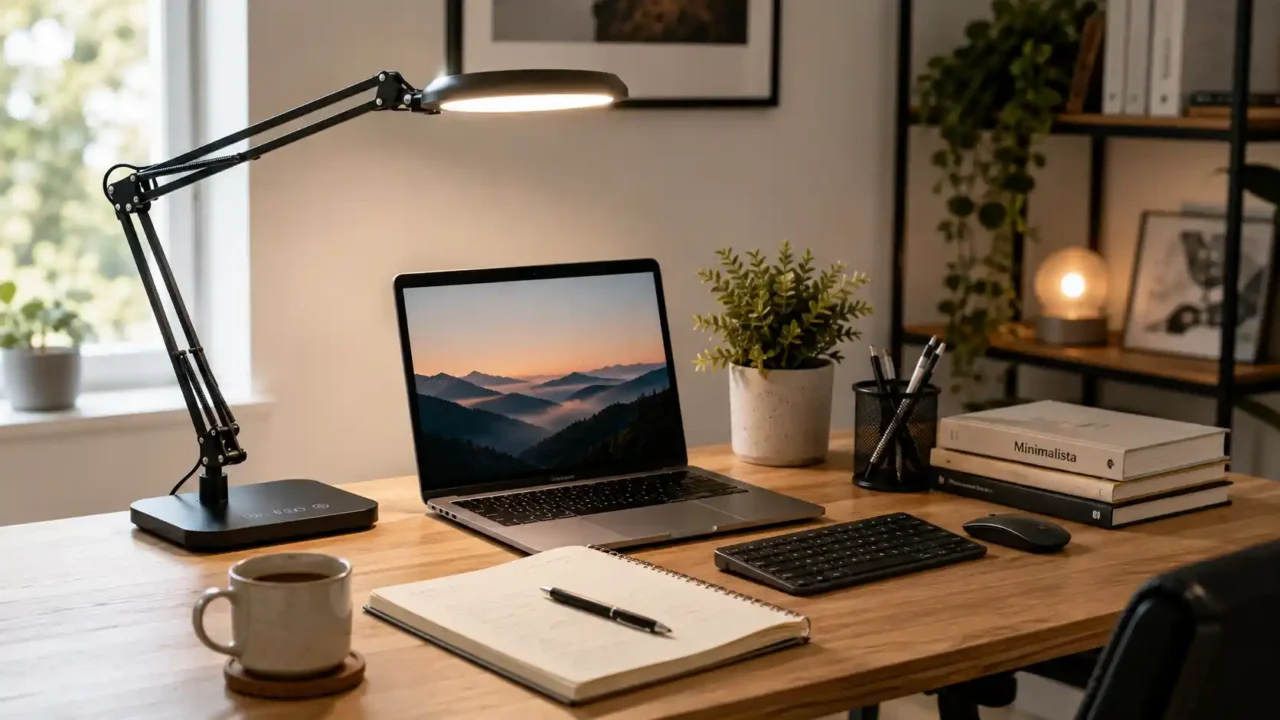
An LED desk lamp buying guide should help you choose a lamp that makes your desk easier to use, not just brighter.
A good desk lamp can improve the way you work, read, study, write, plan, or handle small tasks. A weak lamp can create glare, shadows, eye strain, annoying reflections, or a desk setup that looks good but feels uncomfortable after an hour.
The best desk lamp is not always the most expensive one. It is the one that gives you the right light, fits your space, adjusts easily, and supports your normal routine.
This LED desk lamp buying guide focuses on practical details: brightness, color temperature, adjustability, glare control, controls, power options, size, and daily comfort.
Why an LED desk lamp buying guide matters
Desk lighting is easy to overlook because most people focus on the laptop, chair, monitor, keyboard, or storage first. But lighting affects how comfortable a workspace feels.
A dark desk can make reading and writing harder. A harsh light can feel tiring. A lamp that reflects on a screen can be distracting. A lamp with poor adjustment can brighten the wrong area and leave shadows where you actually work.
A practical LED desk lamp buying guide should help you avoid buying a lamp based only on appearance. The lamp has to work with your desk, your eyes, your screen, your room light, and your schedule.
The U.S. Department of Energy explains that LEDs use up to 90% less energy and last up to 25 times longer than traditional incandescent bulbs. That makes LED lighting a practical choice for desks, reading areas, and home office setups.
Before buying, ask:
- Where will I place the lamp?
- Do I need light for reading, laptop work, writing, or crafts?
- Does the lamp create glare on my screen?
- Can I adjust brightness?
- Can I change the light color?
- Is the base stable?
- Does it fit my desk?
- Is it easy to control every day?
The right lamp should make your desk feel calmer, clearer, and easier to use.
1. Start with brightness
This LED desk lamp buying guide starts with brightness because a lamp that is too weak or too harsh will quickly become annoying.
Brightness is often described in lumens. A lower-lumen lamp may work for soft ambient light, but task work usually needs stronger, more focused lighting. Reading, handwriting, drawing, and detailed desk tasks usually need more light than casual laptop browsing.
Look for a desk lamp with adjustable brightness. This gives you more flexibility across different times of day. You may want bright light in the afternoon, softer light at night, and medium light when working near a monitor.
A lamp with only one brightness level can still work, but it gives you less control. If the light feels too intense, you may stop using it. If it feels too dim, it will not solve the problem.
Good brightness should feel useful without feeling aggressive.
2. Check color temperature
A useful LED desk lamp buying guide should explain color temperature because not all white light feels the same.
Warm light feels softer and more relaxing. It can work well for evening reading, journaling, or a cozy desk corner. Neutral white light is often better for general work because it feels clean without being too cold. Cool white light can feel sharper and more energizing, but it may be uncomfortable late at night.
Many LED desk lamps offer multiple color modes. This is useful if your desk has more than one purpose.
For work, neutral light is usually the safest choice. For reading at night, warm light may feel more comfortable. For detailed tasks, cooler light may help with clarity.
A good lamp does not force one lighting mood on every situation. It gives you choices.
3. Look for adjustable arms and heads
This LED desk lamp buying guide recommends adjustability because desk layouts are different.
A fixed lamp may look clean, but it may not put light where you need it. Adjustable arms, rotating lamp heads, flexible necks, and tilting joints make the lamp more useful.
Look for adjustment in at least one of these areas:
- lamp head angle
- arm height
- arm reach
- base position
- rotation
- folding storage
- light direction
If you work on a laptop, the lamp should not shine directly into the screen. If you write by hand, the lamp should reduce shadows from your hand. If you read books, the lamp should point at the page without lighting your face too strongly.
A good lamp should adapt to the task instead of forcing you to adapt to the lamp.
4. Avoid glare and screen reflections
An LED desk lamp buying guide should always include glare because brightness alone is not enough.
Glare can happen when the light source is too exposed, too direct, or positioned badly. Screen reflections can happen when the lamp points toward a monitor, laptop display, tablet, or glossy surface.
To reduce glare, look for:
- diffused light
- adjustable lamp head
- side placement
- matte desk surfaces
- stable lamp positioning
- brightness control
- indirect lighting options
The lamp should brighten the work area, not attack your eyes.
For laptop users, place the lamp to the side instead of directly behind or in front of the screen. Try to keep the light aimed at the desk surface, not the display.
A good lamp makes the workspace easier to use without creating a new visual problem.
A good lamp also works better when the rest of your desk is comfortable, so pair it with laptop accessories for desk setup comfort if you work from a laptop every day.
5. Check the base, clamp, and desk fit
This LED desk lamp buying guide also looks at how the lamp physically fits your desk.
Some lamps have a flat base. Others use a clamp. Some are tall and narrow. Others are wide, heavy, or designed for large desks.
A base lamp is easy to move, but it takes desk space. A clamp lamp saves surface space, but it needs a desk edge that can hold it. A tall lamp can light a wider area, but it may look oversized on a small desk.
Before buying, check:
- base width
- lamp height
- cord length
- clamp compatibility
- desk thickness
- weight
- stability
- whether the lamp tips easily
If your desk is small, a clamp lamp or slim-base lamp may be better. If you move your setup often, a regular base may be easier.
For a broader desk refresh, compare this choice with home office accessories that make your desk more comfortable.
6. Choose controls you will actually use
A practical LED desk lamp buying guide should focus on controls because convenience matters every day.
Some lamps use touch controls. Some use physical buttons. Some have sliders, remote controls, app controls, memory modes, timers, or motion sensors.
Touch controls look modern, but they can be annoying if they are too sensitive. Physical buttons can be more reliable. A memory function is useful because the lamp remembers your last brightness and color setting.
Useful control features include:
- brightness adjustment
- color temperature adjustment
- memory mode
- simple on/off button
- timer
- clear button layout
- easy access from sitting position
Avoid lamps with controls that are confusing or too dependent on an app. A desk lamp should be simple to use when you are tired, busy, or focused.
The best control system is the one you use without thinking.
7. Decide whether USB or wireless charging matters
This LED desk lamp buying guide treats charging features as optional, not essential.
Some LED desk lamps include USB ports, USB-C ports, wireless charging pads, or extra power features. These can be useful if your desk has limited outlets or you want to charge a phone nearby.
But charging features should not be the main reason to buy a weak lamp. A lamp with poor light quality is still a poor lamp, even if it charges a phone.
Consider charging features if:
- your desk has few outlets
- you charge your phone while working
- you want fewer cables
- the lamp still has good lighting features
- the charging area is easy to use
Skip charging features if they make the lamp bulky, expensive, or less reliable.
Lighting quality comes first.
Best LED desk lamp for home office use
An LED desk lamp buying guide for home office use should focus on comfort over decoration.
For home office work, look for adjustable brightness, neutral white light, glare control, a stable base, and flexible positioning. If you work long hours, avoid lamps that are too harsh or too small.
A home office lamp should support video calls, reading notes, typing, planning, and screen work. It should also look clean enough to stay on the desk every day.
For laptop setups, side lighting is usually better than front lighting. For monitor setups, avoid placing the lamp where it reflects in the screen.
A practical lamp should make your desk feel easier to use, not more crowded.
Best LED desk lamp for reading and study
An LED desk lamp buying guide for reading and study should focus on clear, comfortable task lighting.
Reading needs enough brightness to see text clearly without making the page shine. Study sessions often need longer use, so adjustability matters. A warm or neutral color mode can be more comfortable in the evening.
For students, a lamp with brightness levels, flexible angle control, and a stable base is usually more useful than a lamp with many decorative features.
For reading, look for soft but focused light. For studying, look for steady lighting that does not flicker, glare, or create strong shadows.
Comfort matters because a lamp you dislike will not become part of your routine.
What to avoid when buying
A smart LED desk lamp buying guide should also warn you about features that look good but do not help much.
Be careful with lamps that have:
- very weak brightness
- no brightness adjustment
- harsh exposed LEDs
- unstable bases
- short power cords
- confusing touch controls
- oversized designs
- poor screen glare control
- unclear product dimensions
- too many app-only features
Also avoid buying only because a lamp looks perfect in a product photo. Desk photos are staged. Your desk may have a laptop, notebook, mug, phone, cables, keyboard, and other accessories.
If a discount is the reason you are tempted to buy, check whether the deal is actually useful before choosing a lamp.
A desk lamp should earn its space every day.
How much should you spend?
This LED desk lamp buying guide does not treat price as the only quality signal.
A cheaper lamp can be fine if it has enough brightness, simple controls, a stable base, and decent adjustability. A mid-range lamp may be worth it if it adds better color modes, smoother adjustment, and better build quality. A premium lamp may make sense if you use your desk for long hours every day.
Spend more when:
- you work at your desk daily
- glare control matters
- adjustability matters
- you want better build quality
- you need multiple light modes
- you want long-term reliability
Spend less when:
- the lamp is for occasional use
- you need a simple reading light
- your room already has good lighting
- you are testing desk placement first
A good buying decision starts with your actual desk habits.
Quick checklist before buying
Use this LED desk lamp buying guide as a checklist before you choose:
- Is the brightness adjustable?
- Does the color temperature fit your routine?
- Can you aim the light where you need it?
- Does it reduce glare?
- Will it fit your desk?
- Is the base stable?
- Are the controls easy?
- Is the cord long enough?
- Do you really need charging features?
- Will you use it every week?
If the answer is unclear, wait before buying. A lamp is a small product, but it affects your desk every day.
Final thoughts
A LED desk lamp buying guide should help you choose lighting that supports your routine, not just your room style.
Start with brightness, color temperature, adjustability, glare control, desk fit, controls, and optional charging features. Then compare the lamp against your real use: laptop work, reading, study, writing, planning, or general home office tasks.
The best desk lamp is easy to adjust, comfortable to look at, stable on your desk, and simple enough to use every day.
Use this LED desk lamp buying guide before buying, and you will be more likely to choose a lamp that improves your workspace instead of adding another unused accessory.