An air purifier buying guide should help you choose a machine that fits your room, your routine, and your real air-quality concerns.
Air purifiers can look simple online, but the details matter. A model may be too small for the room, too loud for sleep, too expensive to maintain, or too bulky for the space where you actually need it. Some shoppers focus only on price or design, then discover later that filter replacements cost more than expected.
This air purifier buying guide focuses on practical buying decisions: room size, filter type, CADR, noise level, placement, maintenance, controls, and long-term value.
A good air purifier should be easy to place, easy to run, easy to maintain, and realistic for the room where you plan to use it.
Why an air purifier buying guide matters
An air purifier buying guide matters because air cleaners are not one-size-fits-all products.
A bedroom, small office, living room, nursery, and open-plan apartment may all need different air cleaner sizes. A person buying for pet hair may care about different features than someone buying for dust, smoke, pollen, odors, or general indoor comfort.
EPA says many factors need to be considered when deciding whether an air cleaner is appropriate in a particular setting. That is why the best choice depends on your room, pollutant sources, ventilation, and how you plan to use the device.
Before buying, ask:
- What room will I use it in?
- How large is that room?
- Do I need it for dust, pollen, pet dander, odors, smoke, or general comfort?
- Can I sleep with the noise level?
- How much do replacement filters cost?
- Is the purifier easy to move?
- Does it fit the room without blocking walkways?
- Will I actually run it every day?
This air purifier buying guide starts with practical fit because the best purifier is the one you can use consistently.
1. Match the purifier to the room size
The first rule in any air purifier buying guide is simple: match the purifier to the room.
A small air purifier may work well on a bedside table or small office, but it may struggle in a large living room. A large unit may clean more air, but it can be louder, heavier, and more expensive than you need for a compact room.
Look for room-size guidance from the manufacturer, but do not treat it as the only decision. Also think about ceiling height, open doors, connected spaces, pets, dust sources, and how often the purifier will run.
For bedrooms, quiet performance matters. For living rooms, coverage matters. For home offices, noise and placement matter. For kitchens, odor expectations should be realistic because air purifiers are not a replacement for proper ventilation.
This air purifier buying guide recommends choosing a model with a little room-size margin instead of buying the weakest option that barely matches your space.
2. Understand filter type
A useful air purifier buying guide should explain filters without making the decision complicated.
Many popular air purifiers use a multi-stage system. A pre-filter may catch larger particles like hair and lint. A HEPA-style or true HEPA filter may target smaller airborne particles. An activated carbon filter may help with some odors.
When comparing filters, look for:
- pre-filter
- HEPA or true HEPA filter
- activated carbon layer
- washable parts
- replacement filter cost
- replacement schedule
- filter availability
- simple installation
Do not buy only because the product description uses impressive words. Check what filter it uses, how often it needs replacement, and whether replacement filters are easy to buy.
A strong air purifier buying guide should treat filters as an ongoing cost, not just a product feature.
3. Look at CADR and airflow
This air purifier buying guide includes CADR because airflow performance matters.
CADR stands for Clean Air Delivery Rate. It is used to describe how much filtered air a purifier can deliver for certain particles. A higher CADR generally means the purifier can clean more air faster, but it still needs to match the room and noise expectations.
Do not look at CADR alone. Also check fan speeds, room size, energy use, and sound level. A purifier that performs well only on its loudest setting may not feel useful if you cannot tolerate that noise.
For daily use, a good purifier should perform well at a setting you can actually live with.
If a product hides airflow details or gives only vague claims, compare it carefully before buying.
4. Check noise level before choosing
A practical air purifier buying guide should always include noise.
A purifier may be technically powerful but too loud for sleep, calls, study, reading, or focused work. Noise matters most in bedrooms, nurseries, shared rooms, home offices, and small apartments.
Look for decibel ratings when available. Also read reviews that mention real-world sound. Some purifiers are quiet on low speed but distracting on high speed. Others create a soft fan sound that some people like for sleep.
Consider where you will use it:
- bedroom: quiet low-speed mode
- home office: low background noise
- living room: moderate sound may be acceptable
- nursery: gentle operation and simple controls
- pet area: stronger airflow may matter more
This air purifier buying guide recommends choosing noise comfort before buying maximum power. A quieter purifier that runs daily may help more than a loud one you keep switched off.
If you are improving a work area, pair clean air planning with home office accessories that make your desk more comfortable.
5. Think about placement and layout
An air purifier buying guide should help you plan where the unit will go before you buy it.
Air purifiers need space around the intake and outlet. If you push the unit behind furniture, under a table, inside a corner, or against curtains, performance may suffer. A purifier also needs to be easy enough to reach so you can change settings and replace filters.
Before buying, measure:
- floor space
- distance from walls
- outlet location
- cord length
- height
- walkway clearance
- nearby furniture
- room airflow
For small rooms, a compact purifier may be easier to live with. For larger rooms, a floor unit may make more sense.
A room with crowded floors already feels harder to clean, so a laundry hamper for small spaces can support the same clutter-control routine in bedrooms, bathrooms, or compact apartments.
This air purifier buying guide recommends choosing placement first, then buying the purifier that fits that placement.
6. Compare controls and smart features
A modern air purifier buying guide should separate useful controls from gimmicks.
Some features are genuinely helpful. Auto mode can adjust fan speed based on detected air conditions. Sleep mode can dim lights and reduce fan noise. Filter reminders can help you maintain performance. A timer can be useful if you want the purifier to run for a set period.
Useful features include:
- sleep mode
- auto mode
- filter replacement indicator
- timer
- child lock
- dimmable display
- simple fan-speed controls
- easy-to-read buttons
- app control if you actually want it
Avoid paying extra for smart features you will never use. An app-controlled purifier is not automatically better if the physical controls are confusing.
A good air purifier buying guide should put everyday usability above novelty.
7. Calculate filter replacement cost
This air purifier buying guide treats filter replacement as part of the real price.
The purchase price is only the beginning. Some purifiers need replacement filters every few months. Others may last longer depending on use, air quality, pets, smoke, dust, and manufacturer guidance.
Before buying, check:
- replacement filter price
- how often filters should be replaced
- whether generic filters are available
- whether the brand sells filters consistently
- shipping cost
- filter bundle options
- warranty terms
A cheaper purifier can become expensive if filters cost too much. A more expensive purifier can be reasonable if filters last longer and are easy to find.
If price is the main reason you are interested, check whether the deal is actually useful before choosing an air purifier.
A reliable air purifier buying guide should always include ownership cost, not just the first purchase.
Best air purifier for bedrooms
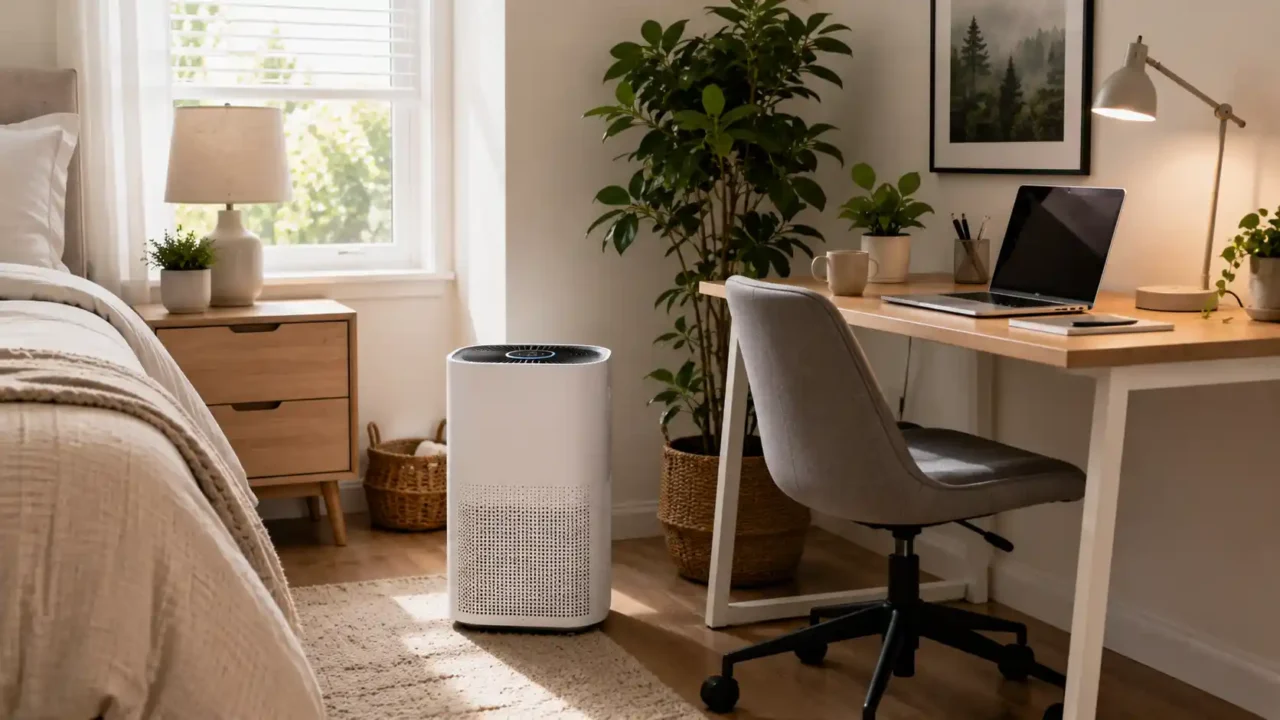
An air purifier buying guide for bedrooms should focus on quiet operation, sleep mode, dim lights, and easy filter maintenance.
A bedroom purifier should not disturb sleep. Look for low noise, no bright display, stable placement, and enough coverage for the room. If the purifier sits near the bed, controls should be easy to reach but not too bright at night.
For bedrooms with pets, dust, or open windows, stronger filtration may be useful. For very small bedrooms, avoid oversized models that take too much floor space.
The best bedroom air purifier is one you can run regularly without noticing it too much.
Best air purifier for home offices
An air purifier buying guide for home offices should focus on noise, size, and where the unit sits during calls or focused work.
A purifier that hums loudly near your microphone may become annoying. A purifier placed too close to your desk may blow air directly at your hands or face. A purifier placed too far away may not feel useful.
For home office use, choose a model that runs quietly on a medium or low setting and fits beside the desk without blocking your movement.
If your office setup includes laptops, lamps, chargers, notebooks, and other desk tools, keep the purifier off the desktop unless it is designed for small spaces.
Best air purifier for pet homes
An air purifier buying guide for pet homes should focus on pre-filters, filter cost, airflow, and easy cleaning.
Pet hair can collect quickly, so a washable or easy-access pre-filter may help. Pet dander and odors may require stronger filtration and more frequent maintenance. A carbon layer may help with some smells, but do not expect one purifier to replace cleaning, grooming, litter maintenance, or ventilation.
Pet homes may also need more frequent filter checks. If replacement filters are expensive or hard to find, the purifier may become frustrating over time.
Choose a model that is easy to clean around and simple to maintain.
What to avoid
A smart air purifier buying guide should warn against products that rely on vague claims.
Be careful with:
- unclear room-size claims
- no filter replacement information
- very cheap filters with poor availability
- loud operation
- no sleep mode for bedrooms
- oversized units for small rooms
- tiny units marketed for large spaces
- confusing app-only controls
- no clear warranty
- ozone-related claims that sound too aggressive
Also avoid buying only because the product is trending. A purifier should match your actual room and use case, not just a social media video.
This is especially important when buying trending products online, where product photos and viral claims can make ordinary devices look more powerful than they are.
How much should you spend?
This air purifier buying guide does not treat the highest price as the safest choice.
A basic model can work for a small bedroom or office if it has good filtration, suitable coverage, and acceptable noise. A mid-range model may be better if you want stronger airflow, quieter operation, better controls, and more reliable filters. A premium model may make sense for larger rooms, heavy use, or advanced features you will actually use.
Spend more when:
- the room is large
- you need quiet daily operation
- filter availability is strong
- you want auto mode
- you have pets
- you plan to run it often
Spend less when:
- the room is small
- use is occasional
- you are testing placement
- you do not need smart features
- filter cost is your main concern
A good purchase balances the purifier price, filter cost, room size, and daily comfort.
Quick checklist before buying
Use this air purifier buying guide as a final checklist:
- Does it match the room size?
- Is the filter type clear?
- Are replacement filters affordable?
- Is CADR or airflow information available?
- Is it quiet enough for the room?
- Does it fit the space?
- Are the controls simple?
- Does it have sleep mode if needed?
- Is the display dimmable?
- Will you actually run it daily?
If several answers are unclear, wait before buying.
A purifier is most useful when it fits the room, the routine, and the maintenance budget.
Final thoughts
An air purifier buying guide should help you avoid hype and choose a product that works in real life.
Start with room size, then compare filter type, airflow, noise, placement, controls, and filter replacement cost. Do not choose only by design, discount, or smart features.
The best air purifier is not the one with the biggest promises. It is the one that fits your room, runs quietly enough to use often, and stays affordable to maintain.
Use this air purifier buying guide before buying, and you will be more likely to choose a purifier that supports daily comfort instead of becoming another unused home appliance.