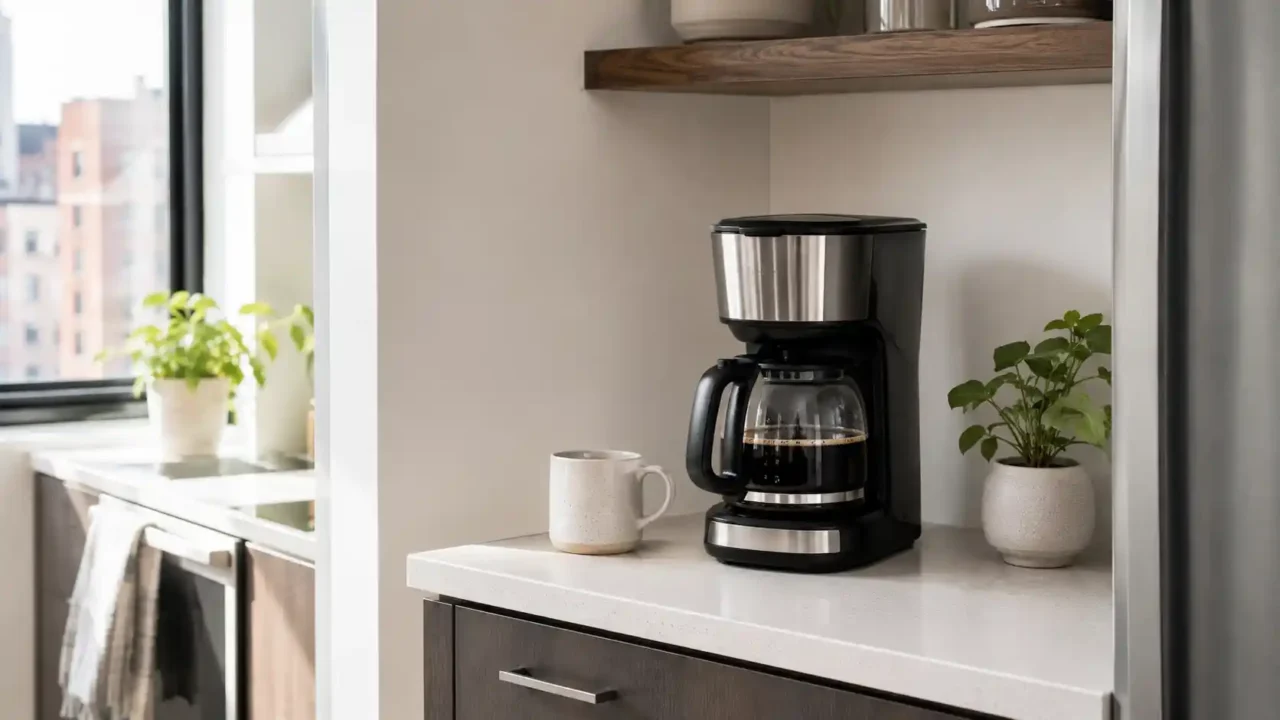
A coffee maker for small kitchens should save counter space without making your morning routine feel cramped. The right choice is not always the smallest machine on the shelf. It is the machine that fits your counter, your cabinets, your daily coffee habits, and the way you actually move around the kitchen.
Small kitchens are different from large open counters. Every inch has a job. A bulky brewer can block prep space, crowd the sink area, or make a cabinet door hard to open. A smart compact brewer should feel easy to use, easy to clean, and easy to store if it cannot stay on the counter all day.
Start With the Counter Space You Really Have
Before comparing features, measure the space where the machine will live. Check width, depth, and height. Height matters more than many buyers expect because some brewers open from the top. If the lid hits the underside of a cabinet, a compact brewer can become annoying even if it technically fits.
Also think about the area around the machine. You need room to pour water, remove the carafe, open the pod chamber or filter basket, and wipe spills. Your brewer should not force you to move three other items every time you brew.
If your counter is already full, read our guide to kitchen gadgets for everyday cooking before adding another appliance. A small kitchen works best when every tool earns its place.
Choose the Brewing Style That Matches Your Routine
A drip machine is useful if you make several cups at once. A single-serve brewer can be practical if one person drinks coffee at a time. A compact espresso machine may look attractive, but it often needs extra space for beans, cups, cleaning tools, and a milk frother.
A coffee maker for small kitchens should match your real routine, not your imagined weekend routine. If you drink one cup before work, a giant 12-cup machine may waste space. If two people drink coffee every morning, a tiny single-cup brewer may become slow and frustrating.
Think about whether you want speed, volume, flavor control, or simplicity. The best coffee maker for small kitchens is the one you will use without creating clutter.
Check the Water Tank Position
Water tank placement can make or break the experience. Rear tanks often require you to pull the machine forward. Side tanks may need clearance near a wall. Removable tanks are easier to fill at the sink, especially in narrow spaces.
A compact brewer should make refilling simple. If you have to slide the machine forward every morning, the footprint is not as small as it looks. A compact model with a bad water tank design can feel larger than a slightly wider model with better access.
Look for clear water markings, a stable tank handle, and a design that does not drip across the counter when refilling.
Think About Cabinet Clearance
Many buyers measure only the machine base. That is a mistake. Lids, filter baskets, pod doors, and bean hoppers need vertical space. A coffee maker for small kitchens should work under your actual cabinets with enough clearance for daily use.
If the machine opens from the top, measure it fully open. If it uses pods, check whether the lid lifts high or slides forward. If it has a grinder, check the bean hopper height. A low-profile coffee maker for small kitchens may be better than a tall machine that looks compact from the front.
This is especially important if your kitchen has upper cabinets, shelves, or a microwave shelf above the counter.
Decide Whether You Need a Thermal Carafe
Glass carafes with hot plates are common, but they keep a heating element active after brewing. Thermal carafes hold coffee warm without relying on a hot plate, but they can cost more and may be taller or heavier.
A coffee maker for small kitchens with a thermal carafe can be useful if you want to brew and move the carafe to the table or desk. That frees the counter and reduces the need to keep the brewer active. For small spaces, that flexibility can matter more than an extra feature button.
If you prefer a glass carafe, check for auto shut-off and easy cleaning. You can also check CPSC recalls and product safety warnings before buying any small appliance, especially one that heats water.
Look for Simple Controls
Touchscreens, apps, clocks, and specialty modes can look impressive, but simple controls often work better in tight kitchens. A coffee maker for small kitchens should be easy to operate when you are tired, busy, or standing in a narrow space.
A clean button layout can also reduce mistakes. If the machine has programmable features, make sure you will actually use them. If not, a simpler model may be lighter, cheaper, and easier to maintain.
The same principle applies to all small appliances. When comparing a coffee maker for small kitchens, ask whether each feature saves time or simply adds complexity.
Consider Cleaning Before You Buy
Coffee machines need regular cleaning. Grounds spill, water tanks collect residue, and carafes stain. If a compact machine is hard to clean, it may become a daily irritation.
A coffee maker for small kitchens should have removable parts that are easy to reach. Check whether the filter basket comes out smoothly. Look at the carafe opening. See whether the drip tray or pod bin can be removed without tilting the machine.
Cleaning also affects where the machine should live. If you need to rinse parts often, placing the brewer near the sink may be smarter than placing it in a decorative corner.
Watch the Cord and Outlet Situation
Small kitchens often have limited outlets. A coffee maker for small kitchens should have a cord that reaches safely without crossing the sink, stove, or prep area. Avoid creating a setup where the cord hangs in front of drawers or gets pinched behind another appliance.
Do not overload one outlet with several heat-producing appliances. If your coffee maker shares space with a toaster, kettle, air fryer, or microwave, plan how those items will be used. A compact brewer is not helpful if the electrical setup becomes messy or unsafe.
This is another reason to avoid buying only by looks. The safest coffee maker for small kitchens is one that fits the full counter and outlet environment.
Match Capacity to Your Household
Capacity matters, but bigger is not always better. A 4- or 5-cup brewer may be enough for one or two people. A single-serve brewer may be best for occasional coffee drinkers. A larger drip machine may still make sense if several people drink coffee every morning.
A coffee maker for small kitchens should reduce friction. If you refill water constantly or brew several rounds every morning, the machine may be too small. If you make half a pot and waste the rest, the machine may be too large.
Think about weekdays first. Your normal routine should decide the machine size. Weekend entertaining should not dominate the decision unless it happens often.
Compare Storage and Countertop Use
Some buyers want a coffee machine that stays out all the time. Others want one that can be stored in a cabinet. A coffee maker for small kitchens should be judged by how you plan to use it.
If it stays on the counter, appearance and footprint matter. If it goes into a cabinet, weight and handles matter. A lightweight brewer can be easier to move, but it should still feel stable when pouring water or removing the carafe.
When you compare a deal, check the real dimensions and return policy. Our guide to spotting a useful online deal can help you avoid buying a machine that looks good in photos but does not fit your kitchen.
Do Not Ignore Noise
Noise can matter in apartments, shared homes, and early mornings. Some machines beep loudly. Some grinders are noisy. Some pump-based brewers make a noticeable vibration on thin counters.
A coffee maker for small kitchens should not disturb the whole home if you brew early. If the product description mentions a grinder, pump pressure, or alert sounds, read reviews carefully. Look for comments about noise, vibration, and whether the machine moves during use.
Quiet operation is not always listed as a main feature, but it can make the difference between a machine you love and one you avoid.
Check Cup Height and Travel Mug Fit
Many compact machines have limited cup clearance. If you use a tall travel mug, check the maximum mug height before buying. A coffee maker for small kitchens should support the cups you already use.
Some models have removable drip trays that create extra room. Others require brewing into a small cup and pouring into a larger mug. That extra step may not sound important, but it can become annoying every morning.
If you often leave home with coffee, mug clearance may be more important than carafe size.
Think About Filters, Pods, and Ongoing Costs
The machine price is only part of the cost. Paper filters, pods, descaling solution, replacement water filters, and cleaning tablets can add up. A coffee maker for small kitchens should also fit your storage space for supplies.
Pods are convenient, but they need storage and create recurring cost. Paper filters are simple, but you need to keep them stocked. A reusable filter can reduce waste, but it needs rinsing and cleaning.
Before buying, compare the machine plus the supplies you will need for the next six months. If you are comparing trending products online, do not let a discount hide the long-term cost.
Best Features to Prioritize
For most small kitchens, the most useful features are practical rather than flashy. Look for compact dimensions, front or removable water access, easy cleaning, auto shut-off, clear controls, stable base, and cup clearance that matches your mugs.
A coffee maker for small kitchens does not need every brewing mode. It needs the right features for your space. If a machine saves two inches but makes refilling awkward, it may not be the better choice. If a slightly larger model is easier to clean and safer to use, it may be the smarter buy.
Final Thoughts
A coffee maker for small kitchens should make your morning easier without taking over the room. Measure carefully, check cabinet clearance, review water tank access, consider cleaning, and match capacity to your real routine.
The best coffee maker for small kitchens is not simply the smallest one. It is the machine that fits your space, your outlets, your cups, your cleaning habits, and your daily coffee rhythm. Choose a compact brewer that solves a real problem, and your kitchen will feel more organized every morning.