Building a home gym sounds exciting, but it can also become expensive very quickly. The good news is that home gym essentials for beginners do not need to include large machines, complicated equipment, or a full room of fitness gear.
This home gym essentials for beginners guide is designed to help you start with useful equipment instead of buying too much too soon. Most beginners need a simple setup that helps them train consistently. That means choosing equipment that is useful, easy to store, comfortable to use, and suitable for more than one type of workout.
A smart beginner home gym should help you build strength, improve mobility, support cardio, and make exercise easier to repeat. You do not need everything on day one.
This guide breaks down the home gym essentials for beginners that are actually worth considering before you spend money on equipment you may not use.
Why a simple home gym works best
A beginner home gym should remove friction, not create more of it.
If your workout area is too complicated, crowded, or difficult to set up, you may avoid using it. A few reliable pieces of equipment can be better than a room full of items that look impressive but stay untouched.
The best home gym essentials for beginners are usually simple tools that support many exercises. They help you train your full body without needing a commercial gym membership or large machines.
A simple setup also makes it easier to stay consistent. You can work out before breakfast, after work, during a short break, or whenever you have a few free minutes.
For general adult activity guidance, the CDC explains how much physical activity adults need each week.
That is why home gym essentials for beginners should be simple, flexible, and easy to use often.
1. A good exercise mat
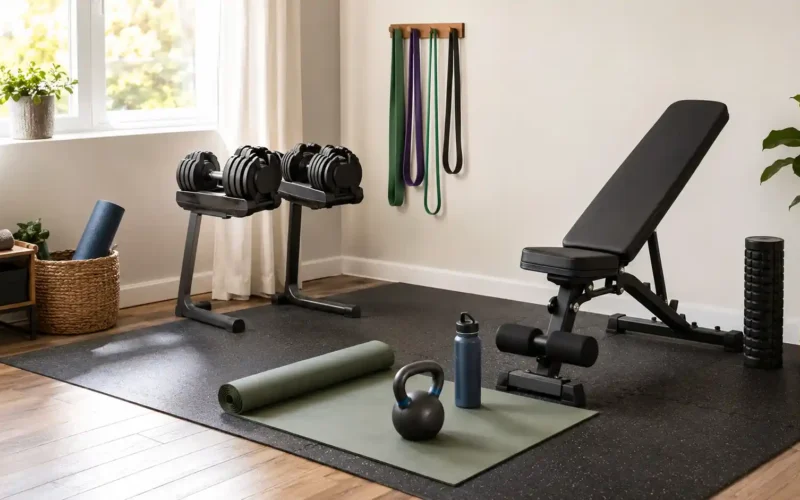
An exercise mat is one of the easiest home gym essentials for beginners to justify.
It gives you a cleaner, more comfortable surface for stretching, core work, mobility exercises, yoga, Pilates, and bodyweight training. If you exercise on hard floors, a mat can make a big difference.
When choosing a mat, look for:
- Enough thickness for comfort
- A non-slip surface
- Easy cleaning
- Enough length for your height
- Material that does not tear quickly
- Storage-friendly design
A very thin mat may be fine for yoga but uncomfortable for knees, elbows, and floor exercises. A very thick mat may feel comfortable but unstable for balance movements.
For most beginners, a medium-thickness mat is the safest starting point.
A mat belongs on almost every home gym essentials for beginners list because it supports so many basic exercises.
2. Adjustable dumbbells or a basic dumbbell pair
Strength training is much easier at home if you have dumbbells.
You do not need a complete rack at the beginning. A basic pair of dumbbells or adjustable dumbbells can support many exercises, including squats, lunges, presses, rows, curls, shoulder raises, and core movements.
Dumbbells are useful because they allow you to train both upper and lower body. They also help you progress gradually as your strength improves.
When comparing dumbbells, check:
- Weight range
- Grip comfort
- Storage space
- Material quality
- Ease of adjustment
- Floor protection
Adjustable dumbbells can save space, but they usually cost more. Fixed dumbbells are simple and durable, but you may need more pairs over time.
For beginners, the best choice is usually the one that fits your budget and gives you room to progress. For strength training, dumbbells are one of the most useful home gym essentials for beginners.
3. Resistance bands
Resistance bands are affordable, light, and easy to store. That makes them one of the most practical home gym essentials for beginners.
They can be used for warm-ups, mobility work, strength training, stretching, rehab-style movements, and travel workouts. They are also helpful if you do not have space for heavier equipment.
Resistance bands can support exercises such as:
- Rows
- Glute bridges
- Lateral walks
- Shoulder warm-ups
- Assisted stretching
- Chest presses
- Biceps curls
- Triceps extensions
There are different types of bands. Loop bands are useful for legs and glutes. Long resistance bands with handles can feel more like cable exercises. Flat bands are often used for stretching and mobility.
If you are starting from zero, a small set with different resistance levels gives you more flexibility.
Resistance bands are also home gym essentials for beginners because they are affordable, compact, and easy to use.
4. A sturdy bench or step platform
A bench is not always necessary on day one, but it can make a home gym more useful.
A sturdy bench allows you to perform presses, rows, step-ups, seated exercises, split squats, and supported movements. If you do not have a bench, a strong step platform can sometimes work for simpler exercises.
Before buying, check:
- Weight capacity
- Stability
- Foldable design
- Adjustable positions
- Floor grip
- Storage size
Avoid anything that feels unstable. A bench should not wobble during exercises.
For small homes or apartments, a foldable bench can be a better option. It gives you more training variety without permanently taking over your space.
5. A jump rope or simple cardio tool
Cardio does not always require a treadmill, bike, or rowing machine.
A jump rope is compact, affordable, and effective if your joints tolerate it. It can be used for short conditioning sessions, warm-ups, and interval training. It also takes almost no storage space.
If jumping is uncomfortable, other beginner cardio options include:
- Walking pad
- Mini stepper
- Stationary bike
- Low-impact aerobic routines
- Bodyweight circuits
The best cardio tool is the one you can use safely and regularly. If you live in an apartment, also think about noise, floor impact, and available space.
A practical home gym essentials for beginners list should include cardio, but it does not need to start with a large machine.
6. Storage that keeps equipment visible
Storage may not sound like fitness equipment, but it matters.
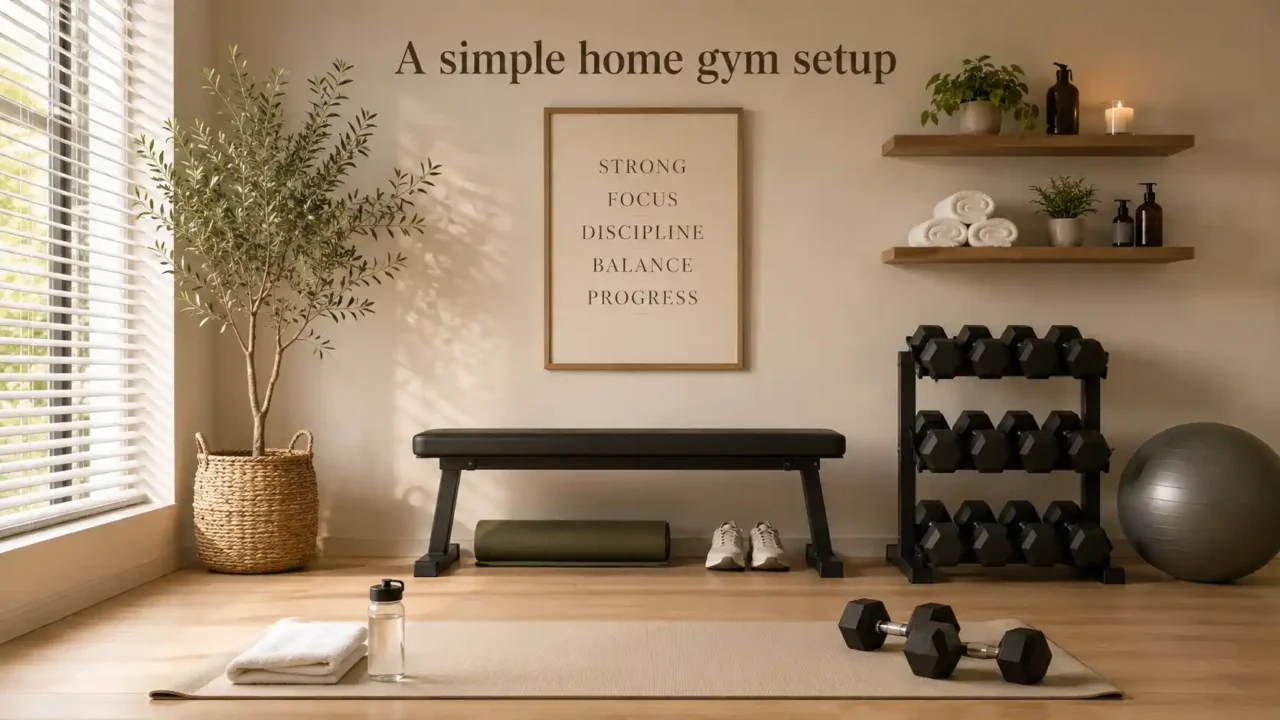
If your gear is scattered around the room, it can make your home feel messy. If your equipment is hidden too well, you may forget to use it. Good storage keeps your workout tools accessible without creating clutter.
For a small beginner setup, consider:
- A basket for bands and small accessories
- A corner rack for dumbbells
- Wall hooks for bands or jump ropes
- A mat strap or holder
- A small shelf for towels and water bottle
If you work out near a desk or shared room, a more comfortable home setup can also make the space easier to use every day.
The goal is not to build a showroom. The goal is to make your workout space easy to start and easy to reset.
For beginners, visible and simple storage can support consistency.
7. A water bottle, towel, and basic workout accessories
Small accessories are easy to overlook, but they make workouts smoother.
A water bottle, towel, timer, notebook, or phone stand can help you stay organized during training. These items are not exciting, but they support the habit.
Useful small accessories include:
- Water bottle
- Workout towel
- Timer or interval app
- Phone stand
- Training notebook
- Foam roller
- Yoga blocks
- Ankle straps, if using bands
Do not buy every accessory at once. Start with what solves a real problem in your routine.
The best home gym essentials for beginners are the items that make it easier to train again tomorrow.
What you do not need at the beginning
Many beginners overspend because they try to copy a full gym.
You probably do not need large machines, advanced cable systems, heavy racks, or expensive smart fitness devices when you are just starting. Those can be useful later, but they are not required to build a good routine.
At the beginning, avoid buying equipment only because it looks impressive online.
You may not need:
- A full treadmill
- A large weight rack
- Multiple machines
- Expensive smart mirrors
- Heavy barbell setups
- Complicated attachments
- Equipment you do not know how to use
Start with simple gear. Add more only when your workouts prove that you need it.
How to choose equipment for a small space
A small space can still become a useful workout area.
You do not need a garage or spare room. A bedroom corner, living room space, balcony, or office area can work if the equipment is easy to move and store.
For small spaces, choose:
- Foldable items
- Stackable equipment
- Multi-use tools
- Compact dumbbells
- Resistance bands
- A rollable mat
- Storage baskets or racks
Measure the area before buying large items. Also check whether you have enough space to move safely during exercises.
The same space-first thinking applies when choosing home products that need to fit smaller rooms.
The most useful home gym essentials for beginners are the ones that fit your real home, not an imaginary perfect gym room.
How much should beginners spend?
There is no single correct budget.
A very basic setup can start with a mat, resistance bands, and a pair of dumbbells. That may be enough for stretching, strength training, mobility work, and short home workouts.
A larger beginner setup might include adjustable dumbbells, a bench, storage, and a cardio tool. That gives you more variety, but it also costs more.
Before spending more, ask:
- Will I use this every week?
- Does it support multiple exercises?
- Does it fit my space?
- Can I store it easily?
- Is it safe for my current level?
- Will it help me stay consistent?
It also helps to check whether a deal is actually useful before buying fitness equipment just because it is discounted.
A smart beginner gym grows with your habits. It does not need to be complete from the first day.
Common beginner home gym mistakes
The most common mistake is buying too much too soon.
Another mistake is buying equipment without a plan. A machine may look useful, but if you do not know how it fits into your workouts, it may become clutter.
Beginners also sometimes buy gear that is too advanced, too heavy, or too large for their space.
Avoid these mistakes:
- Buying equipment before choosing a routine
- Choosing bulky gear for a small room
- Buying weights that are too heavy
- Ignoring storage
- Forgetting floor protection
- Choosing cheap equipment that feels unsafe
- Copying someone else’s setup without considering your own needs
A good home gym should make exercise easier, not more stressful.
Final thoughts
The best home gym essentials for beginners are simple, practical, and easy to use consistently.
Start with a mat, resistance bands, dumbbells, and a few small accessories. Add a bench, cardio tool, or storage solution when your routine needs them. Keep the setup clean, safe, and realistic for your space.
You do not need a perfect gym to start exercising at home.
The right home gym essentials for beginners should make your first workouts easier, not make the setup feel complicated.
You need a setup that makes your next workout easier to begin.